
What I learned this week - Pretraining parallelisms, Can distillation be stopped, Mythos and the cybersecurity equilibrium, Pipeline RL, On why pretraining runs fails
April 15, 2025
At the end of my conversation with Michael Nielsen, we talked about how to actually retain what you learn. Michael’s advice was to make some kind of demanding artifact. Write something up. Try to explain it. So in that spirit, here are notes on some topics I’ve learned about over the last week or two. These notes are extremely rough, and have many mistakes.
Pretraining parallelisms
Notes from an excellent lecture that Horace He gave my friends and me. I wrote these notes to try and retain what I learned. They’re extremely rough - I’m sure there’s many mistakes, and all of them are mine.
What made this lecture so good is that Horace built up the whole topic as a chain of problems and solutions: here’s what we want to do, here’s why it breaks, here’s how we fix it, here’s why that fix eventually breaks too. Most explanations just list out a hodge podge of different strategies, without ever connecting them to the problems they solve or explaining why you’d pick one over another. As a result I came away understanding things I’d only had a surface-level grasp of before, from how collective operations actually work and where they sit in the stack, to the high-level implications of hardware constraints for the nature of AI training.
Equation for pretraining flops = 6ND. 2 FLOPs per parameter per token for the forward pass (multiply + add). Backward pass is 2× forward because you compute gradients w.r.t. both input matrices. So 2 + 4 = 6.
Okay we can’t do all this on one GPU. So how do we split up this problem? The obvious solution is to do data parallel - where you copy the model weights across each GPU, and you just do a part of the batch on each GPU.
The obvious problem is that each GPU only has a limited amount of HBM - B300 is 288GB - and this is not enough to store the weights as models get bigger and bigger, much less their activations.
Okay so next thing we try is fully sharded data parallel - each GPU only stores 1/N of the parameters of each layer - before processing each layer, you all-gather the full layer’s parameters from all GPUs (each GPU only stores 1/N of each layer). After processing, each GPU discards the gathered parameters.
It was emphasized that this is the go to default.x And you only move on from this when having too many GPUs forces you to move on, for reasons explained later. The reason this is the default is that it’s trivial to overlap compute and communication time - that’s because the only thing being communicated is the weights, which are not dependent on what happened in the layer before, so you can start all gathering the next layer while you’re still computing this layer. Compare this against tensor or expert parallelism, which do need to share activations for one layer before you can process the next one. The problem with pipeline parallelism is bubbles as explained below.
From a comms volume perspective, FSDP looks insanely expensive at first — you all-gather every layer’s full weights across all GPUs, use them for one matmul, then throw them away. But this ignores what regular data parallelism already costs you - in regular DP, you still need to do an all reduce after every layer of the backwards pass in order to sync the batch’s gradients across all the GPUs. That all-reduce has comms volume of params × 2. FSDP adds all-gathers — one per layer in the forward pass, one per layer in the backward pass. But an all-gather is half the comms volume of an all-reduce. So naive FSDP comms volume ends up being # params * 4 (all gather forward and back, plus all reduce on back). You can do even better: since each gradient shard only needs to end up on the one GPU that owns it, replace the all-reduce with a reduce-scatter (which skips the final broadcast step). That gets you to params × 3 total — a 50% overhead over vanilla DP.
So why can’t you always just do FSDP?
Comms crossover: You want your compute time to be greater than your comms time - you don’t want to be bottlenecked on comms. But since compute time for FSDP decreases as you increase the number of GPUs, and comms time does not, as you scale the number of GPUs on FSDP, your MFU can totally crater. When this happens, you need to add pipeline parallelism too.
Compute time = (6 * # tokens * active params) / (compute per GPU * number of GPUs)
This decreases as you increase number of GPUs
Comms time = (# total params * 3) / (nv link domain size * infiniband BW)
Comms time does not increase as you add more domains. This was really confusing to me. Each domain collectively holds all the parameters, and you need to sync gradients across domains after each layer of the backward pass. You’d think that adding more domains means more hops in the ring, so the all-reduce gets slower. But the standard ring algorithm splits the message into one chunk per participant. More domains means more hops, but proportionally smaller chunks per hop. (This breaks down when chunks get so small that per-hop latency dominates, at which point you switch to tree algorithms.)
Technically, you can do better than a naive single all reduce for the gradients between all the domains. You do a hierarchical collective to optimize comms time across multiple NVLink domains. Key thing to remember is that each GPU in the domain gets its own bandwidth access to infiniband. So you wanna use it all up since interconnect bandwidth is the bottleneck. You do this by trying to do as much as possible within a scaleup before you move out. So you do reduce scatter within a scale up to give each GPU the domain-level reduced gradients for a shard of the layer, then all reduce these shards across corresponding GPUs across domains, then all gather within a domain. This shifts the comms time line down, thus moving the crossover point to the right.
Made an animation to illustrate it using Cursor and Composer 2:
If you look at the equations, you can see that if you increase batch size, crossover point moves to right, and if you make the model more sparse, moves to the left.
Also why TPUs are better at FSDP - because more accelerators within a domain.
Batch size floor: FSDP is data-parallel, so each GPU processes at least one sequence. Attention is computed within a sequence and can’t (easily) be split across GPUs. If your critical batch size is 10M tokens and sequence length is 10K, you only have 1K sequences — so you can’t scale beyond 1K GPUs with pure FSDP, even if you have plenty of comms bandwidth left.
Problems with pipeline parallelism (the next addition you’d make to FSDP in order to deal with these issues):
The problem with pipeline parallelism is different - there you have bubbles that emerge from the fact that at the beginning of the batch, the GPUs dedicated to the final layers are not being used, and conversely at the end of the batch, the GPUs dedicated to the first layers are not being used. The reason you can’t overlap batches in training to solve pipeline bubbles is that you need to consolidate gradients and update the model before you process the next batch.
But also you’re adding architecture constraints - things like Kimi’s attention-to-residuals (where each block attends to all previous layers’ residuals) become very difficult when those residuals live on different pipeline stages. Similarly, interleaving sliding-window and global attention layers could cause load imbalance across stages. Dealing with all this slows down research iteration, which is the greatest sin you can commit.
Can distillation be stopped?
Can the frontier labs stop distillation? Because if they can’t, open source commoditizing models can catch up incredibly rapidly, making the long run business model for the labs less viable. Let’s say it takes 1T tokens from a frontier model to capture its juice (I have no idea if that’s correct, but let’s say). Even ignoring savings from caching, Opus 4.6 is $25/MTok. So $25 million for those 1T tokens. That’s nothing.
Labs are responding by hiding chain of thought. But there’s two problems with this solution:
Chain of thought is not made of some fundamentally different kind of token. You can just instruct the model to not think first but just start solving the problem, or to write out its thinking somewhere else.
Even if labs do figure out how to robustly hide chain of thought to train in the future, you can make reconstructing the chain of thought necessary to reproduce a decoded sequence as an RLVR target. Yes that costs more, but seems doable.
Maybe most importantly, the real juice of these agentic models is their tool use (writing and updating files of code, running bash commands, etc). And if these things are done locally on the user’s computer, you can’t really hide them. And it seems like a hard lift to get users to migrate all their development workflows to a cloud that you fully control and hide visibility to, modulo a Claude agent input text prompt.
By the way, I learned about an interesting way companies which build products atop API access to AI models can basically distill these models, in a way that potentially makes the distilled models even better than the ones they’re actually built atop.
Suppose you’ve got a coding product. In order to build a feature, a user uses your product to query some frontier model API across 10+ back and forths. Once the user is satisfied with the end result, you have the end state that the user actually wanted - “the gold diff”. These coding product companies can now set the gold diff as the RL target for training their own models, where the model gets rewarded for producing outputs that look like what users eventually converged on, and penalized for producing the kinds of intermediate outputs that users kept rejecting or editing.
Mythos and the cybersecurity equilibrium
It seems like the key difference between Mythos and previous versions is that while previous versions could find individual vulnerabilities in the code (“Hey, there’s a missing bounds check here”), Mython is long run agentic enough to rope 5 different vulnerabilities together which are all required in order to find an exploit (“Now I can execute arbitrary code, escalate privileges, etc”). To the extent that some discontinuity has been hit, it’s probably more the result of the combinatorial nature of cyberattacks rather than some off-trend increase in intelligence.
What does this mean for offense/defense? One way to look at it is that software is more secure today than it was 20 years ago, despite more and more human intelligence probing at public code, both white hat and black hat. If we get another influx of intelligence suddenly, why should the dynamic change?
In fact, we know that our foreign adversaries almost certainly have access to a bunch of critical zero days which they’re saving for a rainy day, or already using in inconspicuous ways. To the extent that Glasswing allows the whole industry to find a bunch of these latent exploits and patch them, shouldn’t we expect defense to have become much stronger relative to offense by the end of 26? Of course, this is thanks to the fact than American companies got there first and are cooperating with other companies and our government to patch things before our adversaries get to the same level.
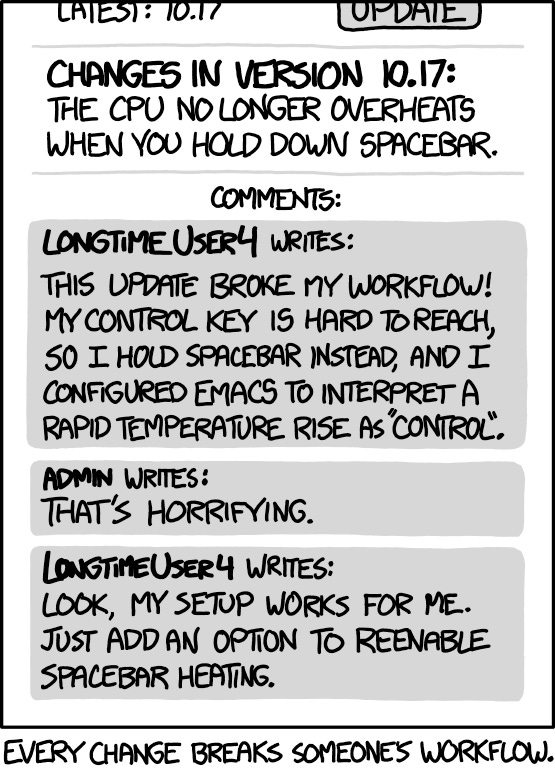
One counterpoint I heard from a security expert is that there’s big difference between finding vulnerabilities and patching them - and AI is much better at the first than the later (people often talk about the offense/defense balance, but difficulty of finding versus patching vulnerabilities seems much more significant). In order to patch an issue, you have to find a fix that will not interfere with all the ways people use your software, and all the features which rely on weird bespoke behavior. XKCD has a nice comic illustrating how these kinds of issues come up:
Potential solutions, if it’s non-trivial to just push patches to every piece of software?
TODO - I know nothing about formal verification of software - check out what a seL4 proof of some behavior might look like
Use LLMs to rapidly port all C to Rust. Curious how easily Mythos can find vulnerabilities in memory safe languages.
In some sense, its good that Anthropic didn’t release this model publicly until critical IT could be patched up. In another sense, isn’t it a super bad precedent for private companies to be hoarding the ability to be able to break into any operating system and browser and device? One obvious question for Anthropic is why they didn’t just build some kind of classifier which would detect whether you’re using the model for cyberattack type stuff, and refuse requests if yes, and release that publicly.
Patching your own software is isomorphic to finding bugs in someone else’s repo from the perspective of an LLM (and patching your own software is a frequent coding model use case).
These kinds of classifiers can be easy to evade if you have enough expertise to break the problem of finding exploits down into smaller subproblems of finding vulnerabilities which each individually seem like sensibly good behavior to an LLM with no memory
Pipeline RL paper summary
As you keep RLing a model, not only does the average length of a response increase (since you’re basically training the model to think for longer before answering) but the variance in length also increases - sometimes you get an easy problem and you can immediately answer it - other times, you need to go think for 100k tokens.
This is a big problem for GPU utilization on training. Because you have to wait for all these stragglers to finish generating before you can start the next training step.
Okay one way you could get out of this conundrum is to just to just batch generation so that while stragglers keep going, you generate even more rollouts.
The problem is that there is an optimal batch size for each training step, so you’d need to split all these rollouts you made across lots of consecutive training steps.
But this takes you into the domain of offline RL, because your model is changing with each training step. And so you’re training your model on trajectories that were actually generated by an earlier model, which is not ideal.
Pipeline RL paper proposes the following fix: in flight weight weight updates - where you just sub out the generating model partway though these generating trajectories as soon as the new training step is done, so all the short trajectories, and a good chunk of the long trajectories, that the next training step will be trained on are generated by the most recent version of the model.
On why pretraining runs fails
Had an interesting chat with someone on why pretraining runs often fail. It was very interesting to get a sense of all the tangible ways that things can get fucked, and why training is such a precarious operation. At a high level, breaking causality, and adding bias, seem to be key culprits.
Breaking causality:
When you do expert routing, you first go through the router, which gives you a score of how much each token wants each expert. There’s two ways to proceed from here: 1. Token routing, where you read the scores from the token’s perspective, and allocate to each token’s top k experts. Problem is that you could end up with wildly unbalanced allocation across experts, which is terrible for performance. Alternatively, you could (and only in training) do expert choice, where you just split the tokens by which are more relatively preferred by each expert. This way you can enforce that each expert gets roughly the same number of tokens. But the big problem is that this breaks causality, because which expert token n gets allocated to may depend on which expert token n + k might be router to. And breaking causality is very bad, because you’re getting information in training (and updating based on it) that you wouldn’t see in deployment.
Rumor is that this explains why Llama 4 and Gemini 2 were underwhelming.
I guess you could do expert choice during prefill inference? But maybe it doesn’t work well in practice to allocate tokens to experts which would not have received that token in actual training.
Tbh I don’t fully understand why breaking causality is so bad. I understand you can’t see beyond causality in real inference. But why is this minor deviation such a big issue?
Another thing that can break causality is token dropping. Where experts just ignore the tokens in the batch that they’re supposed to process, but which rank not so strongly, and cutting whom would spare going outside padding. This breaks causality cause a later token being more strongly matched to this expert might lead to an earlier token getting ignored.
Apparently this was an issue with Gemini 2 Pro.
Adding bias:
Bias much worse than variance - variance can average out, but bias compounds
Apparently the original GPT 4 training was slow and got initially fucked because of the following bug: they were using FP16 on their collectives like all-reduce. FP16 distributes its granularity according to logarithmic density - between 1 and 2, the mantissa bits carve the interval ~0.001 apart. But 1024 and up, the mantissa might be carving the interval by multiple whole number values. Suppose some collective involves adding 1 + 1 … 10,000 times - you could get in a situation where as soon as you get to 1024, you add 1, it goes to 1025, you round down to the nearest interval at 1024, add one again. And so the calculated value is 10x off the real value. Huge issue if you’re trying to sum many small gradients into a large accumulator. And imagine how hard the bug must have been to find!
Implications for AI training:
Some of the people who think we can cure aging argue that there’s basically 5 different ways people die of old age (heart disease, cancer, etc), and that if we cure these 5 different diseases, then we’d basically have solved again. You could ask a similar question about these failed pretraining runs - are there 5 different ways training runs fail, in which case once a lab figures out numerics and , you’ll just have smooth sailing, or will you keep seeing new bespoke issues emerge at each new level of scale? The person I talked to seemed to think the later - he pointed out that even within numerics, there’s so many ways you can fuck things up. And new ones will keep emerging at scale.
Bearish on AI fully automating kernel writing anytime soon. Presumably this is because he thinks it’s more of an AGI complete problem than some give it credit for. There’s another school of thought that says, “Hey, which kernel gets attention or MLP to run fastest on this scaleup is a super verifiable domain, thus we can RL to superhuman performance easily.” But he says, it took Nvidia, which has the best kernel engineers in the world, a long time to optimize for Blackwell, which suggests that actually it’s quite hard, and might not be super easy to close the loop on.
Sometimes people say inference for RL generation and inference for end user generation is basically the same. But this person pointed out that in RL inference, numerical drift between inference and training engine can cause these subtle off policy biases, which matter a ton for highest quality training. But are not an issue if just serving to users.
Emphasized how important it is to have a disciplined process for amalgamating compute multipliers, because of the risks of stacking up bugs with subtle biases.


