This is the final episode of the Sarah Paine lecture series, and it’s probably my favorite one.
Sarah gives a “tour of the arguments” on what ultimately led to the Soviet Union’s collapse, diving into the role of the US, the Sino-Soviet border conflict, the oil bust, ethnic rebellions and even the Roman Catholic Church. As she points out, this is all particularly interesting as we find ourselves potentially at the beginning of another Cold War.
As we wrap up this lecture series, I want to take a moment to thank Sarah for doing this with me. It has been such a pleasure.
If you want more of her scholarship, I highly recommend checking out the books she’s written. You can find them here.
Watch on YouTube; listen on Apple Podcasts or Spotify.
Sponsors
Labelbox helped me create a tool to transcribe our episodes! I’ve struggled with transcription in the past because I don’t just want verbatim transcripts, I want transcripts reworded to read like essays. Labelbox helped me generate the exact data I needed for this. If you want to learn how Labelbox can help you (or if you want to try out the transcriber tool yourself), go to labelbox.com/dwarkesh
Sardine doesn’t just assess customer risk for banking & retail. Their AI risk management platform is also extremely good at detecting fraudulent job applications, which I’ve found useful for my own hiring process. If you need help with hiring risk—or any other type of fraud prevention—go to sardine.ai/dwarkesh.
Gemini’s Nano Banana Pro helped us make many of the visuals in this episode. For example, we used it to turn dense tables into clear charts so that’d it be easier to quickly understand the trends that Sarah discusses. You can try Nano Banana Pro now in the Gemini app. Go to gemini.google.com.
Timestamps
(00:00:00) – Did Reagan single-handedly win the Cold War?
(00:15:53) – Eastern Bloc uprisings & oil crisis
(00:30:37) – Gorbachev’s mistakes
(00:37:33) – German unification and NATO expansion
(00:48:31) – The Gulf War and the Cold War endgame
(00:56:10) – How central planning survived so long
(01:14:46) – Sarah’s life in the USSR in 1988
Transcript
00:00:00 – Did Reagan single-handedly win the Cold War?
Sarah Paine
Thank you for coming. It’s a treat to be with you and sharing all this stuff. Since we seem to be in a second Cold War, maybe it’s a good time to revisit the last one to see why it turned out the way it did and why the participants in it thought it turned out the way it did.
I’m going to pose the question: why did Russia lose the Cold War? People have loads of different answers to that question. This is going to be a tour of the counter-arguments. I’m going to start with an answer that many Americans have. It’s a very simple one that’s like, “Ronald Reagan single-handedly defeated the Soviet Union.” That’s one possible answer. But then I’m going to give you all kinds of counter-arguments to that.
Some of them are going to be other external explanations of what others did to the Soviet Union. Others are internal ones of what the Soviet Union did, the cards that it didn’t play particularly well. And then I’ve got some umbrella explanations. So that’s my plan for this evening.
The story that Ronald Reagan did it… Well, here’s a picture at the Reagan Ranch after the Cold War is over. You see the Gorbachevs and you see the Reagans and they seem to be having a grand old time, which suggests there’s something maybe off with that explanation.
But anyway, the way the “Ronald Reagan did it” school goes is that Ronald Reagan did a massive military buildup and some would argue it bankrupted the Soviet Union. He was a man of words and deeds. He made really good speeches that were memorable.
Here’s one before Parliament where he says, “The regimes planted by totalitarianism have had more than 30 years to establish their legitimacy, but none—not one regime—has yet been able to risk free elections. Regimes planted by bayonets do not take root.”
And then here he is before the Brandenburg Gate, this is in Berlin, long a symbol of German greatness. But then it was a locked gate on the Berlin Wall. Here’s Ronald Reagan: “General Secretary Gorbachev, if you seek peace, if you seek prosperity for the Soviet Union and Eastern Europe, if you seek liberalization, come to this gate. Mr. Gorbachev, open this gate. Tear down this wall!“
And who can forget the “Evil Empire” speech, which he gave to the National Association of Evangelicals in Orlando, Florida, and they skipped Disneyland to hear it.
Reagan did a very significant military buildup that actually had started under Carter when the Soviets invaded Afghanistan, big mistake as we discovered. He also invested in and deployed missiles in Europe. He was busy funding anti-communist insurgencies and also others who didn’t like the Soviet Union all over the world. He started doing more aggressive military patrolling. By the time he’s out of office, he was like half a dozen ships short of this 600-ship navy or whatever it is he was planning to make. He was also trying to build a missile shield, his Strategic Defense Initiative.
The problem is the Soviets tried to match him on this. If you add up the GNPs of the United States, NATO allies, and Japan, well, that would be seven times larger than the Soviet GNP. You’ve got to be aware of asymmetric strategy. The CIA thought during the Cold War that perhaps Russia was spending up to 20% of its GNP on defense. After the Cold War ended, when you were getting more accurate statistics, it turns out it was at least 40 or 50%. Some people say it was up to a truly economy-busting 70%, if you take into account all the infrastructure investments that were associated with military things. If you look during the Cold War, the United States was spending less than 8%, Germany less than 6%, Japan less than 2%, and Nazi Germany, which is no piker, 55%. So you look at all this and it was difficult.
So I am going to be quoting lots of Russians today because they have thought deeply about the fate of their country, how life as they knew it disappeared, the Soviet Union gone, the empire gone. They thought a lot about it. Here is a former Soviet ambassador to West Germany, Valentin Falin. Here’s his take: “Following the American strategy of our exhaustion in the arms race, our crisis in public health and all the things that have to do with standard of living reached a new dimension.” Then if you add to the arms race of the United States the arms race that was going on with China on that border, the arms race plunged the Soviet economy into a permanent crisis.
Here you have Georgy Arbatov, who was the late Soviet Union’s finest expert on the United States, or at least the most famous one. He’s looking at the Soviet war in Afghanistan. He said, “It is quite clear that the Afghan war was most advantageous for the United States. And we got our Vietnam.” Because the United States is busy funding the other side, and it’s costly. Gorbachev is looking at this, as he’s telling the Politburo a year after he came into power. He said, “Look, the Americans are betting precisely on the fact that the Soviet Union is scared of this SDI, the Strategic Defense Initiative, a missile defense. That’s why they’re putting pressure on us, to exhaust us.” Correct.
So some would argue that the US victory in the arms race guaranteed victory in the Cold War. Go Ronnie. That’s one explanation. But I’m going to give you a tour of the counter-arguments and some other explanations, starting with Presidents Ford, Carter, and the Helsinki Declaration.
After World War II, the Soviets had wanted to convene a conference of European states to confirm its expanded World War II borders. And for a long time, nobody was interested. The Western Europeans are sick of all the drama. The United States still doesn’t want to show, but we go along with our allies, and our allies insist on including human rights provisions. We think this is crazy because we know the Soviets are never going to enforce those things. But you get the Helsinki Accords that have all sorts of human rights provisions.
Well, lo and behold, unbeknownst to anybody, dissidents across the Eastern Bloc and human rights activists across the West start holding the communists to account for the agreements that they have signed and start contrasting the liberation that communism promises versus the dictatorship actually delivered. This human rights movement within the Soviet bloc and abroad, took on a life of its own.
Here you have the former director of the CIA and former head of the Department of Defense, Robert Gates, saying, “The Soviets desperately wanted this big conference and it laid the foundations for the end of their empire. We resisted it for years only to discover years later that this conference had yielded benefits beyond our wildest imagination.” Go figure.
Here is Jimmy Carter with his human rights initiative. It was Gorbachev’s English language translator who said that Carter’s emphasis on precisely the human rights that were denied to Soviets really resonated and it made people think that they wanted a more democratic, open, liberal society. Here’s Carter giving a graduation address at Notre Dame. He said, “We have reaffirmed America’s commitment to human rights as a fundamental tenet of our foreign policy. What draws us Americans together is a belief in human freedom. We want the world to know that our nation stands for more than just financial prosperity. We’re bigger than that.”
And here is Eduard Shevardnadze, Gorbachev’s foreign minister, echoing some of these sentiments. He said, “Look, the belief that we are a great country is deeply ingrained in me, but great in what? Territory? Population, quantity of arms, people’s troubles, the individual’s lack of rights? And what do we, who have virtually the highest infant mortality rate in the world, take pride in? It’s not easy answering the questions. Who are you? Who do you wish to be? A country which is feared or a country which is respected? A country of power or a country of kindness.”
Others agreed that communism was essential to the survival of the Soviet Union, but it’s an undemocratic ideology. Fundamentally, it’s a foundation that can’t endure forever. That’s the take of Vitaly Ignatenko, who’s a Russian journalist. Oleg Grinevsky, who’s a Soviet career diplomat, is saying, “Look, communist ideology is associated above all with the Soviet Union. Its rejection created a vacuum and it determined its ultimate fate.” Boris Yeltsin, who is Gorbachev’s successor, said, “Look, no one wants a new Soviet Union.”
So some would argue, this counter-argument, that human rights clauses of the Helsinki Accords and Carter’s subsequent human rights campaign destroyed communist belief in communism. Okay. Another president, another counter-argument. Those who are fans of Richard Nixon would say, “No, no, no, no, no. It was Richard Nixon who played the China card so the United States and China could gang up on the Soviet Union and overextend it financially to wreck it militarily.”
I think the Chinese would beg to differ and say, “No, no, no, no. It was Mao who played the America card.” Because what’s going on in 1969? There’s a border war between China and the Soviet Union. China’s gotten its nuclear bomb in ‘64. It no longer has to defer to the Soviet Union and starts playing more tough on their border disagreements. So the Soviets are really upset. They come to the United States and ask us whether it would be okay to nuke these people, because they think Americans don’t like the Chinese . Well we didn’t, but we said, “No, it’s not okay to nuke those people.”
So the Chinese figure it out. The one that wants to nuke you is your primary adversary, right? Up until then… Think about it, China and Russia, for them the United States was the primary adversary. Now they’re primary adversaries with each other, freeing up the United States to decide which one it’s going to cozy up to. And the United States decides it’s going to cozy up to China.
Why? Well, Chinese belligerency forces the Soviets. Not only have they already got a big militarized border with Europe, now they’re going to do the same thing on a very long border with China. These are nuclear-armed mechanized forces, very expensive. Imagine if this country had to have such borders with Canada and Mexico. It would be bankrupting, and we are far richer than the Soviet Union was then, whenever. It was bankrupting. So some would argue that US cooperation with China fatally overextended the Soviet Union.
One could take all of these arguments, starting with President Nixon all the way through Reagan, to make an overarching argument that says, “Look, each president opened up opportunities for the others who then leveraged them.” So Nixon plays the China card, which others play with increasing dexterity. Ford comes in and begins dabbling in human rights. Carter then comes in and really goes for human rights and starts doing a military buildup, which then Ronald Reagan really does. So that by the time you get to Reagan, he is dealing in a position of both ideological and military strength vis-à-vis the Soviet Union.
For those who think that US foreign policy was not consistent during the Cold War, you’re not looking at it at the strategic level. There were certain different strategies going on and how best to achieve it, but both parties agreed the goals were free trade, democracy, containment of communism. Those were staples of US foreign policy, for both parties, for its duration.
So some would argue that Presidents Nixon through Reagan produced the cumulative presidential effects to defeat the Soviet Union.
Okay, others would say to forget this great man theory of history business, that’s really passé. What really accounted for the outcome of the Cold War was this military platform, that’s Pentagonese for large military systems. But anyway, it’s a nuclear-powered, nuclear-armed submarine. They say that this is the item.
The way deterrence theory worked during the Cold War, and I believe now as well, is that in order to deter the other side, you have to have a reliable second-strike capability. So if they thought of lobbing a nuke at you, they would be guaranteed that you would have the second strike to lob a nuke back. Therefore, they’re never going to lob the first nuke.
When Jimmy Carter became president, he was a graduate of Annapolis and also a submariner. The United States began a much more aggressive deployment of its fleet and that’s continued even more so under Reagan. We’re taking our submarines and we’re targeting Soviet submarines in their home water bastions. So the Soviets are thinking that we’re going to be able to destroy their second-strike capability on our first strike and they’re having a heart attack.
So here you have Valery Boldin, a longtime aide to Gorbachev, saying, “Look, the most powerful strength of the United States is the naval fleet and we aren’t going to get one, or our geography isn’t set up to use one the way the United States can.” And then you have Marshal Yazov saying, “For the Americans, the main means of atomic attack is the fleet.”
So then you get Marshal Akhromeyev, who’s visiting the United States in 1987. At the end of the Cold War he will kill himself, but he’s still around in ‘87. He’s telling his American hosts, “You know where our submarines are, but we don’t know where yours are. It’s destabilizing. You, you the United States Navy, are the problem.” Go Navy. And here’s his host, Admiral Trost, who’s going, “Yeah, the inability of the Soviet Union to maintain a strong defensive capability led to the demise of the Soviet Union and to the removal of the Soviets as a major threat to us.”
So you can make a perfectly good argument to say the Soviet Union could not counter technologically or financially the US submarine threat to its retaliatory nuclear forces, so war termination was the only thing it could do.
All of these preceding explanations are navel explanations, spelled with an ‘e’, as in staring at one’s own. They’re all about what the United States did or didn’t do. So let’s get beyond the half-court tennis of Team America. You need to look at the other side of the net. This is where the Western guru for things military, Carl von Clausewitz, emphasizes reciprocity in war and the interaction of both sides. You’re not going to do well unless you consider what the other side is doing.
00:15:53 – Eastern Bloc uprisings & oil crisis
So I have given you some external explanations and I’m going to do the internal ones. Here is Arnold Toynbee, he’s one of the finest historians of the 20th century. He wrote a big multi-volume history of the West, in which he argues that civilizations die from suicide, not by murder. So I discussed the murder, what the United States tried to do to the Soviet Union. Now I’m going to talk about the suicide, what the Soviets did to themselves. And here is counter-argument number one. The Soviet Union was an empire, and when that collapsed, that meant they lost the Cold War.
During the Cold War, the Korean War and the Vietnam War, there was much fear in the West of this domino theory. The idea is one country falls to communism, then the next and next and next and next would fall to communism. Turns out the domino theory did not apply to capitalism. It applied to communism because once the democratic contagion hit one Warsaw Pact country in Eastern Europe, it spread to the others until it was a seething mess and they fell like dominoes.
So in 1988-89, there were all kinds of demonstrations in the Eastern Bloc, the Soviet Union. In the Soviet Union, they’re for political freedoms. In the Eastern Bloc, they’re for freedom from the Soviet Union. Gorbachev may not have gotten that detail. They’re all about not only wanting political freedoms, but also they’re about crumbling economies and how to fix their miserable standards of living. Very uncharacteristically, the Russians didn’t send tanks. In fact, Gorbachev welcomed and encouraged reforms in the Eastern Bloc, both political and economic, just as he was doing in the Soviet Union. So his ideas of glasnost, openness, and perestroika, rebuilding, resonated at home and abroad.
These reforms began in Poland. Poland had been a scene of much worker unrest many times, in 1956, 1970, 1976, and 1980 and 1981. In 1981, this is when Solidarity, the workers movement, gets going and it gets a national and an international reputation. The next set of strikes are happening in 1988, because in the preceding several years, the Polish standard of living had shrunk by over 3%.
The government was out of cash and wanted to raise basic food prices, and Poles hit the streets. The government was in a panic, because it was worried the economy would go into free fall. So the government cut a deal with Solidarity. They said, “You call off the strikes and then we’ll let you into political talks,” and Solidarity agreed. There was a complicating factor on all of this. It’s called the Roman Catholic Church, which is an institution of enormous credibility and legitimacy in Poland, which had a partiality for Solidarity and it had a Polish pope.
So the roundtable discussions were these political talks. They occurred a year later in February 1989, and the Soviets encouraged them. In fact, here’s one Soviet person there advising the Poles: “Look, you’ve got to find some quick solutions out of your economic and political mess. You’re an itty-bitty country, so when you make mistakes, they’ll be itty-bitty mistakes. But if we make them, they’ll be big.” They got that one right.
The Polish Communist Party thought they had this one covered by the way they jiggered the election rules. Not quite. The day they held elections is exactly the same day that Deng Xiaoping turned the tanks on demonstrators in Beijing and you have the Tiananmen Massacre. Two solutions for the problem. So the way the elections worked out in Poland is that Solidarity won every single seat for which it could compete but one. And then only three people in the communist-designated seats actually won. So who won all the rest of them? The box on the ballot called “none of the above.” Yes, the Roman Catholic Church had helped instruct people that that’s the box you want. With that, the legitimacy of the Communist Party to rule had just been wrecked and we’re on to democracy in Poland.
This democratic contagion then spread into East Germany four months later. This is about the 40th anniversary of the founding of East Germany. 70,000 people demonstrated in Leipzig. Within the week around like 1.4 million Germans are demonstrating in over 200 demonstrations. Typically, the East Germans would have sent tanks. That was what they would have done in the past. But would-be tank man Erich Honecker was already out of a job. His ruinous policies of living off debt since he came to power in 1971 had just about wrecked East Germany. So he was out.
Then less than two weeks later, the Council of Ministers resigns. Then on November 8th, the Politburo resigns. Then on the 9th, whatever is left of that government is issuing new travel regulations. You might wonder what travel has got to do with it. I’ll get there.
So in response to a question at a news conference, this guy, Günter Schabowski, who was one of the remaining communists helping run the show, gets asked a question and he doesn’t know the answer. So he wings it. The question is, “When do these travel regulations go into effect?” And he goes, “Immediately.” Well, crowds immediately started gathering at the six gates to the Berlin Wall. At one of them, the border guards decided that discretion was the better part of valor, and they opened the gate and East Germans poured into West Berlin.
Within the first week alone, over half of East Germany’s population visited the West. Within the month, 1% of the population emigrated to the West. Like the Polish elections, this opening of the gate was a pivotal decision. A pivotal decision, whatever it is, means there’s no going back to the way it was. Here’s good old Günter going, “Gosh, we hadn’t a clue that opening the wall was the beginning of the end of East Germany.” Okay, better luck next time. And the Russians were shocked by how unpopular they were. They were thinking they were going to get credit, Gorbachev, for Eastern Europe’s liberation rather than blame for Eastern Europe’s enserfment.
Here you have Yuri Ryzhov, a scientist and parliamentarian going, “All of our former satellites by compulsion cast off from us as fast and as far as possible.” And Anatoly Kovalev, who is a deputy foreign minister, said, “Look, we had no confidence whatsoever concerning whom the East German army is going to shoot, the demonstrators or us. And the same thing for the Polish and Hungarian armies.” Great. With allies like this, who needs enemies? The allies kind of cover it. So this argument says unrest in the empire forced the Soviet Union to forfeit the Cold War.
Okay, I got another counterargument. It says, “Nonsense, the real problem was that the satellites were unhealthy. That’s why the whole thing fell apart.
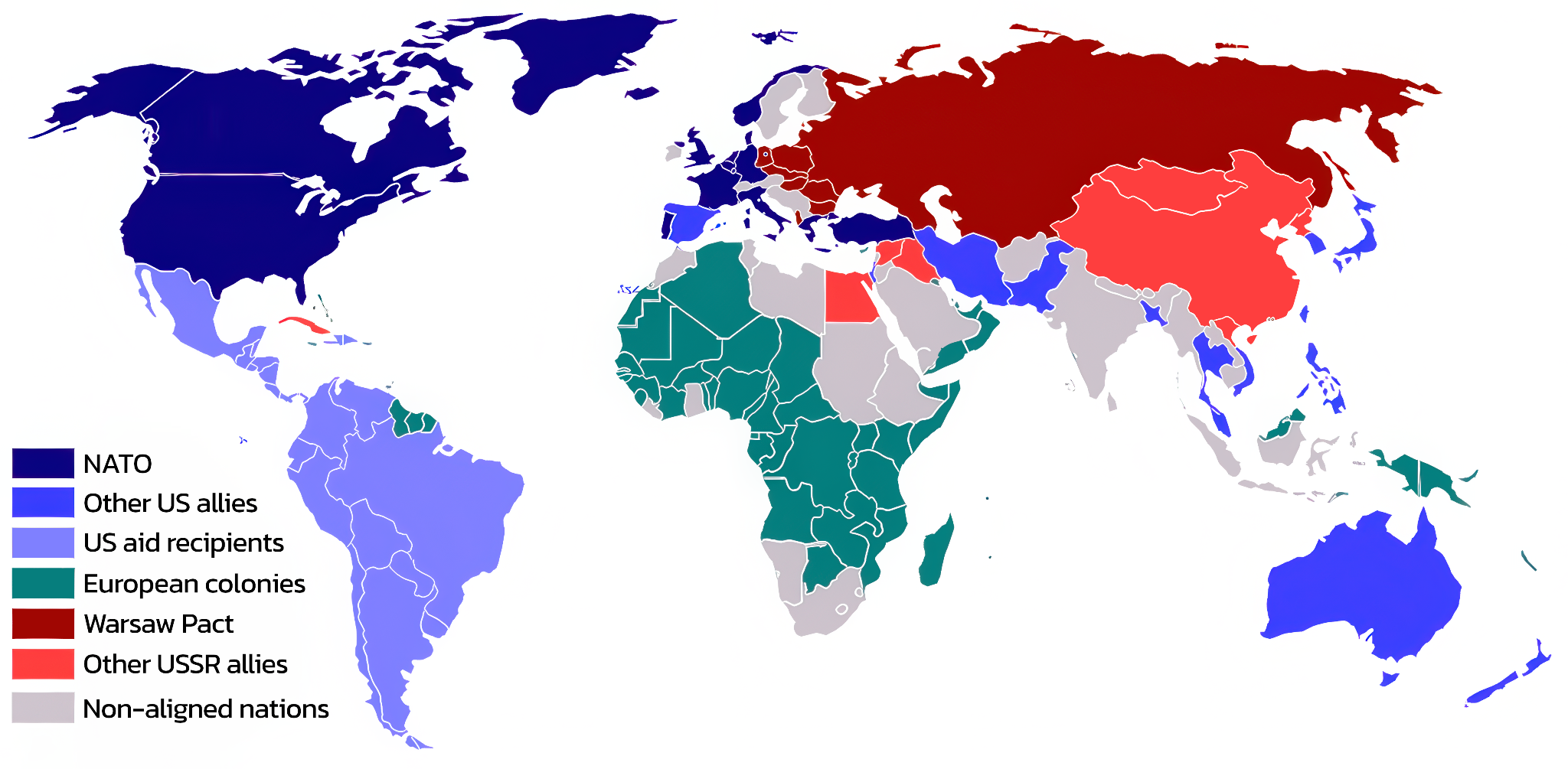
So this map is 1960. You see all those tempting green places. They’re about to become independent, and they are really sick of their Western European colonizers. Enter the Soviet Union with a program to put the West out of business. There were many takers.
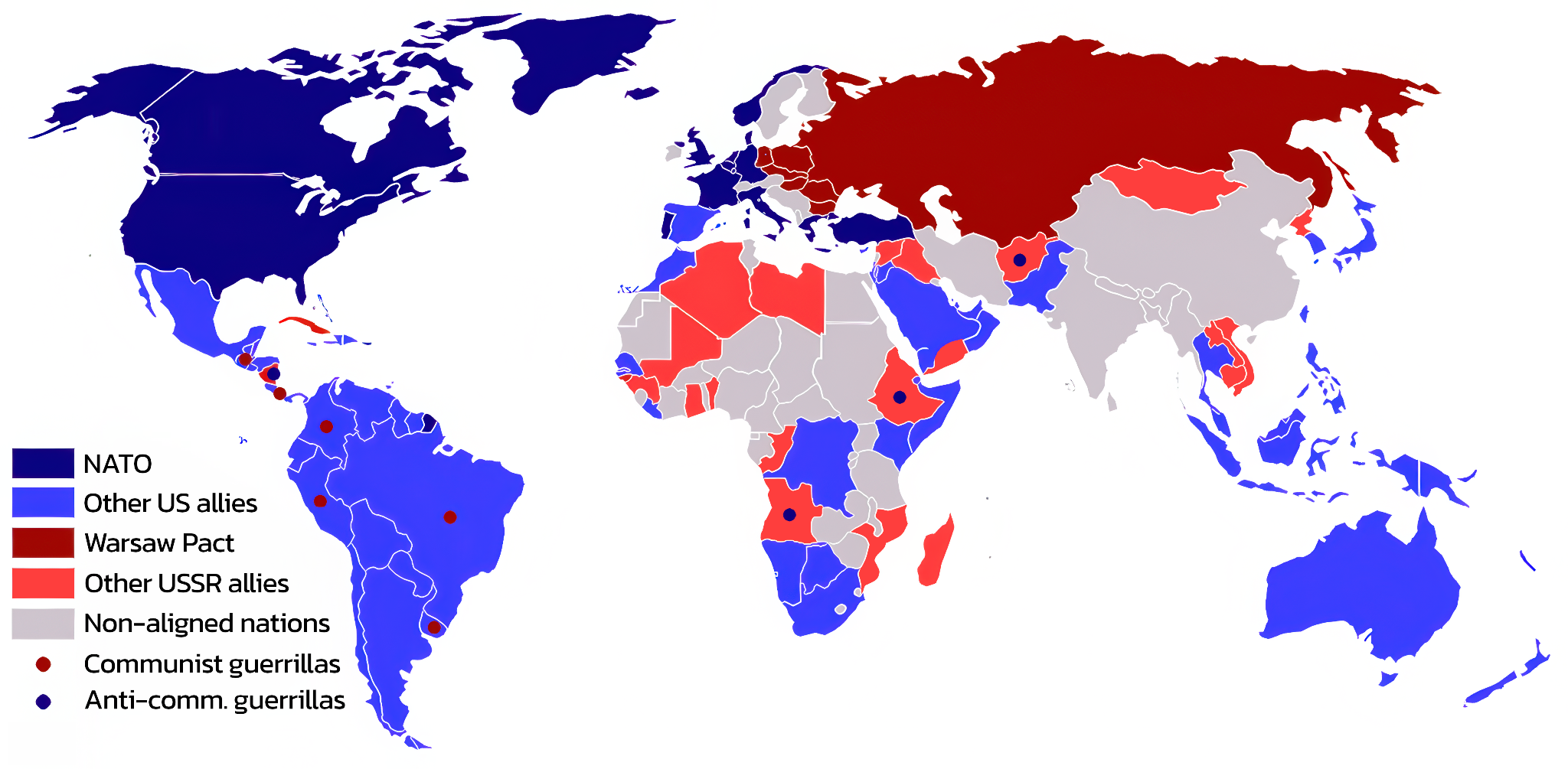
Fast forward to late 1980s. The Soviet Union is on a roll. Small hitch, in the late 1970s there was a big recession that continued into the 80s and tanked commodity prices. For some of the newfound pals like Angola, South Yemen, Ethiopia, Nicaragua, it wrecked their export earnings because they’re exporting commodities and these commodity prices are down. In many cases, it halved them. The Soviet Union was really dependent on oil exports, still is. Oil prices tanked and oil accounted for up to 55% of the Soviet budget. So here Brezhnev has got a deep bench of non-performing piles at a time when he doesn’t have the money to support all of them.
Worse yet from the Soviet point of view, it’s dumped all this money in these Third World friends but meanwhile, it’s got its own nationalities who are deeply unhappy and they want out of the empire. Most problematically, they all revolt at exactly the same time. One of the rules for continental empire is “no two-front wars”. Russia has so many fronts at this point, it can’t even keep count.
The unrest in the internal empire of nationalities started as soon as Gorbachev got in. There were student movements in Kazakhstan and Yakutia, opposite ends of things. By the time you get to 1990, there are like 76 seething ethnic rebellions in different parts of this. There was too much going on for the Soviet government to handle. So you could argue that the Soviet Union bankrupted itself with the Third World while ignoring its own internal Third World of nationalities, whose simultaneous revolts brought down the Soviet Union.
I got a completely different argument for you. If you don’t like all of those, I got another one for you. It’s the economy, stupid, right? That line. One could argue that communism failed as an economic system. If you look at growth statistics for the Soviet Union, they’re pretty good post-World War II when they’re rebuilding, but they really stagnate from the mid-70s onward. For the decade preceding Gorbachev’s coming to power, Soviet growth stats were one to two percent lower than those of the United States, and the compounding effects of that were enormous.
What’s going on? Everyone’s lying to each other. The data that Soviets are using is garbage. If you’re working for a subunit of an enterprise, you have to lie about the inventories you have, saying you have less than you do, and then you have to lie about what you need, saying you need more than you do because you’re worried about getting enough things. It’s not a market system where the price dictates it. This is all about the plan. You’ve got to enter the right numbers and then you get whatever inputs you get from the centralized plan.
So everyone’s lying. They’re aggregating all the lies. The higher up the food chain you aggregate these things, the worse the data is, so that the Soviet government has no idea what the actual value of capital or labor are. It has no idea what actual productivity is, and no one has any idea what consumer preferences are. You’re not using markets and prices. The misallocation of capital and labor goes unnoticed until it metastasizes into a catastrophe.
To give you a sense of these misallocations, the Soviet Union was rotting 20 to 40% of its crops. It’s using scarce hard currency for agricultural imports to make up for those crops, a total mess. You can look at what happens to the economy with oil prices down. We’re into a spiraling mess, so that from when Gorbachev comes in in ‘85 to when it hits a trough in Russia in 1998, you see this crashing share of world GDP by the Eastern bloc. If you look at Soviet statistics on deficits, trade balances, debt, they’re just soaring, and then GNP growth goes double-digit negative. That’s called shrinkage. It’s not the normal thing.
Marshall Yazov, here’s his take: “We simply lack the power of all these wealthy NATO nations. We had to find an alternative to the arms race.” And here’s a foreign service officer, Anatoly Adamishin. He said, “Look, our problems began with the departure from isolation. The main reasons for collapse were internal, not external reasons. The Soviet economy was literally exhausted from this monstrous arms race, militarism, enemies with half the world.” That’s his take. Gorbachev told the Central Committee, “Look, we’re encircled not by invincible armies, but by superior economies.” He often told people, “Living this way any longer is impossible.” So you can make a powerful argument that it’s the Soviet economy that lost the Cold War.
00:30:37 – Gorbachev’s mistakes
This gentleman, Alexis de Tocqueville, is very famous for writing a book about the last days of the French monarchy before the French Revolution overturned it. He also wrote something about Democracy in America, both excellent books. But this one’s from the one about France, where Tocqueville observes, “The most dangerous moment for a bad government is when it begins to reform.”
Russians of all political persuasions agree on at least one thing. That is that Gorbachev’s role in how the Cold War turned out was pivotal, that he played a very essential part. Gorbachev made his decision based on certain false assumptions. One of them was the irreversible direction of history. Gorbachev thought of history going always forward towards communism, never backwards to capitalism. Of course, Eastern Europe took a U-turn, went straight back to capitalism. Here is Leonid Shebarshin, who is a senior person in the KGB, their intelligence office. He said, “The thought never occurred to the government that it’s possible to withdraw from socialism.”
If you think about both communist theory and how imperialism works in practice, usually the mother country is more developed than whatever all the colonies are, right? Well, the Soviet Union was an inverted empire. People in Eastern Europe as a group were more well-educated and they were richer than Russians. It was like a donut empire. So when the empire went to Eastern Europe, Russians could no longer siphon off the wealth of these enserfed populations in Eastern Europe, which explains why they wanted to leave. It also suggests why Putin wants them back.
Another false assumption has to do with the sentiments of the neighbors. Gorbachev was convinced he was going to get credit for liberating Eastern Europe, rather than blame as a Russian for having enserfed them in the first place. For Gorbachev, the clock began on his watch. For other people, no, Stalin’s when it began, when he started shooting a lot of people.
Here you have Anatoly Chernyaev, foreign policy adviser to Gorbachev, saying that Gorbachev thought that bringing freedom to our Eastern European satellites would have them adopt socialism with a human face. “He made an enormous mistake because these countries brutally turned their back on us.” Really, if that’s brutal, then what pray tell was Stalin? And then it gets better: “The politics in connection with our former friends were totally unexpected to us.” Really? You occupy people, you never leave, you shoot a lot of people in their government, you put in a new government, you siphon off a lot of their wealth, and you impose a non-performing economic system, and you wonder why they don’t like you.
Think about the United States. It intervenes all around the world in other people’s troubles. It dumps billions in economic aid and even leaves and people don’t like us. I don’t know why the Russians think they’re so special.
Another false assumption: Gorbachev believed that if the Warsaw Pact, the military alliance of the Eastern Bloc, disappeared, then NATO would disappear. He also believed that if the Comecon, which is their trading organization, went away, then the European Community in those days—it becomes the European Union later—would disappear. Not quite. It turns out that organizations that are coercive versus those that are voluntary, they dissolve for different reasons.
And then Gorbachev also assumed that the United States would share a continental outlook of not wanting strong powers and that the United States therefore would not want a unified Germany, let alone a strong unified Germany. So when all the unrest is happening in Germany, Gorbachev is off taking a vacation. Poor life choice, because at that moment, President George Bush Sr. and Chancellor Kohl of Germany are working on fast-tracking German unification of a fully sovereign, unified Germany—both halves in NATO.
So many of Gorbachev’s closest supporters at the end of it all blamed him. They said, “Look, his foreign policy mistakes were a function of his domestic policy mistakes and it destroyed the Soviet Union.” Back to this America expert, Vladimir Lukin: “Gorbachev was no Deng Xiaoping.” And Arbatov, who’s their premier America expert: “The stupidity of our leaders caused the disintegration of the Soviet Union.” So the big bozo was playing with plastic bags, stuck one on his head, committed suicide. It was by mistake. Lukin continued: “In the West, they love Gorbachev because everything took place so easily and cheaply, basically like that, but only for you. For us, it was expensive.” But you could argue the time to reassess all the Stalinist stuff was long overdue.
Here’s a completely different way of looking at it. I’ve been giving you sins of commission, and now I’m going to do sins of omission. It’s a good framework. It’s useful for other things. The sins of commission are all the things Gorbachev did. Now what I’m going to do is what the army didn’t do. Some would argue that the Red Army should have done exactly what Deng Xiaoping ordered his army to do. You just send the tanks against civilian demonstrators and they truly crush them and it’ll be over. Communist Party is still in power in China 30 years later. So there are some people who believe that this was a terrible mistake.
So this argument would be that timely tank deployments—TTD, my contribution to military acronyms—would have changed the outcome of the Cold War. Others would be back to the great men of history and sins of commission, and they wouldn’t be picking on Gorbachev but his successor Boris Yeltsin. There are two big pieces of evidence when we look. He removed Article 6 from the Soviet Constitution, which guaranteed that the Communist Party would always monopolize power. And then in addition in the following year, Yeltsin’s the head of Russia, he gets together with the heads of Ukraine and Belarus, and they signed the Belavezha Accords, which then formally dissolved the Soviet Union. So according to this way of thinking, it’s his fault. It’s suicide on purpose. And what it does is it opens the door for multiple parties and for the nationalities within the Soviet Empire to become independent.
00:37:33 – German unification and NATO expansion
So I’ve given you internal explanations. I’ve given you external explanations. Now I’m going to give you some umbrella explanations. They’re based on all the preceding evidence, and they come to opposite conclusions. The first one was, well, any of the above, it’s inevitable. The opposite conclusion from the same evidence is that no, it took all of the above. The West barely won.
I’m going to start with “any of the above”. You could argue with this many serious problems, it was a matter of time before the Soviet Union collapsed. It was an objectionable system for precisely the reasons the West didn’t like it. It had a brutally inefficient economic system. Russians who invented the thing, at the end of the day, didn’t want it either. By this way of looking at it, you have people like Yuri Ryzhov, a genuine rocket scientist, who says, “Look, the main reason for the collapse of the Soviet Union is the rottenness of its system.” Then here’s a journalist, Teimuraz Stepanov, who said, “Look, I think from the beginning the genes of disintegration were contained in the genetics of this governmental political formation.” Don’t you love the products of the Soviet educational system? Don’t ever use wording like that.
So you could argue that the Soviet Union was destined to fail with this many problems. Others would come to the opposite conclusion. They would say, “No, it took every single one of them for the Cold War to end on Western terms.” Back to Anatoly Kovalev, the deputy foreign minister, he said, “Look, all these factors merge—internal, ideological, economic, military—it’s all of them. You remove any one of them and you get a different outcome. Maybe the Cold War ends, but it might end completely differently.” So by this line of reasoning, the West barely won and should feel very fortunate that it did.
One can take this last argument and say it was more than that. It also took the confluence in office of two very talented leaders: Helmut Kohl of Germany and George Bush Sr. of the United States, not the son who got into those forever wars, but the dad who didn’t. George Bush Sr. had one of the most amazing resumes of any person ever to become president of the United States. Just look at him. When he’s really young, he’s a war hero in World War II. He’s a Navy pilot, a dangerous thing to do. He did it. Then he comes back and he gets his BA at Yale and graduates with honors. Then he becomes a representative for this district in Texas after he’s already made himself a millionaire in the oil business that he started. Then he became ambassador to the UN, followed by US representative to the PRC, before we had formal diplomatic relations. So he’s the guy who’s setting that up. He becomes director of the CIA, and then he is Ronald Reagan’s understudy for eight years as vice president. He is incredibly fit for the job.
Helmut Kohl is equally fit for the job. He is the longest-serving chancellor in German history since his illustrious predecessor, Otto von Bismarck. He starts out getting a PhD in history and political science. He also starts out in business, but then he works for state government, initially as a representative, then as a governor. He becomes chairman of his political party, the Christian Democratic Union, for a quarter of a century.
Once he gets in, he decides he’s going to buy up East Germany one tourist at a time. How does that work? East Germans, it turns out, really like to travel. West Germans had always been able to travel to East Germany, or they long had been able to travel to East Germany, but East Germans definitely could not easily travel to West Germany. Why? Because they have a habit of staying. But all of a sudden, East Germany eases up on the travel regulations. You might ask why, and the answer would be money. Just like the Poles, the East Germans were deep in an economic mess of their own making.
Would-be tank man Erich Honecker, who got the boot at the very end, well, his staying-in-power paradigm that he implements in 1971 is that he’s going to live off debt. He needs to make certain social benefits available and consumer benefits available for labor stability, to not have labor unrest. The way he’s going to do that is he’s not going to do many domestic investments and he’s going to do a lot of borrowing, particularly from West Germany. Well, that’s unsustainable long-term. By the time you get to the end of the Cold War, if he’s going to fix that and even out the accounts, it would be a 30% decline in the East German standard of living. So he really needs the pocket change from the tourists.
So what Kohl does is a brisk business of tourists and things. What he does in return for the easing of travel restrictions, he pays East Germany several hundred million Deutschmarks extra to allow that to happen. And then he gets the Hungarians to go along. He gets the Hungarians to open up their Austrian border to let East Germans out that way, and he gives them a half a billion Deutschmarks for that little favor.
When Kohl introduces his 10-point unification program—because now he’s thinking he’s going to get both Germanys together—this is when he starts doling out big bucks to the Soviet Union, whose economy is unraveling. Gorbachev is going to be desperate for this cash as that’s happening. So West Germany provides 100 million in food, especially in meat, for the Soviet Union that doesn’t have these things.
Nevertheless, the unrest just keeps on going. The Berlin Wall, as I’ve told you, is breached, and then you wind up with a West German caretaker government, and the financial situation in Russia itself is unraveling. By the time you get to January 1990, Bush and Kohl get together and they decide they want to really fast-track German reunification. Why? Because they’ve got to get it done before this unraveling crisis causes Gorbachev to fall from power. So they have got a game going, the two of them. It’s complicated. Here’s why.
Gorbachev was dead-set against Germany, a united Germany, in NATO. He’s not really keen about a united Germany, let alone one in NATO. The US State Department experts, the guys who know everything, are saying, “No, you want to go slow on this unification business.” Kohl is also running a coalition government. There are people in that government he cannot fire because they’re from different political parties. One of them is his foreign minister, this guy Genscher, who is very skeptical about Germany being part of NATO. Then it turns out, although Britain had talked a good piece during the Cold War, it didn’t actually want a unified Germany, nor did France. Why? Because that unified Germany would eclipse them economically. They didn’t want that to happen.
So Kohl and Bush divide up the tasks. Kohl is going to reassure the Soviet Union that Germany is not going to be belligerent or do horrible things. And Kohl is going to work on financial unification because the Soviets are thinking in terms of military unification. You know, where you deploy your troops. That determines things. Wrong instrument of national power, precisely because the Soviets didn’t understand finance. That’s why they’re in such a mess. Whereas the Germans do. What they’re going to do is get East Germany on the West German Deutschmark, and at that point they will control all the money and they will control decisions. But the Russians aren’t going to see that coming.
Meanwhile, Bush is supposed to work the alliances particularly with Britain and France in the West. There are all sorts of meetings that are coming up. Bush’s job is to delay those meetings for as long as possible so German unification can proceed as far as possible. The two of them are doing a tag-team diplomacy with Gorbachev that he just can’t keep up with, given that his own home economy has got these double-digit shrinkage rates.
Here’s how they go. As the trades get bigger, the amount of money you pay Gorbachev gets bigger. First of all, it’s just to get a unified Germany. Then it’s to get a unified Germany with West Germany still in NATO. Then it’s to get a unified Germany with all of Germany in NATO. So here’s how the money goes. Gorbachev agrees to German unification. We are no longer paying hundreds of millions of Deutschmarks. We’re paying billions of Deutschmarks, five billion Deutschmarks for that one. Then Gorbachev agrees that states can choose their own alliances, i.e. whether or not to join NATO. The US offers nine assurances, but it’s also a trade agreement that Gorbachev really wants. Then the economic union goes into effect.
So we’ve now done the financial reunification of Germany. This is when there’s a London Declaration that’s inviting Eastern European countries to coordinate more closely with NATO. In return, Gorbachev gets a promise of a G7 summit meeting that’s going to fast-track aid to him, which it will do. And then Gorbachev agrees to German NATO membership.
At this point, even bigger things are happening. Germany’s going to agree to its border with Poland. I’ll get there and explain. Germany provides 15 billion in Deutschmarks, including building all kinds of new apartment buildings for repatriated Soviet soldiers who are going home. Why are you doing that? Because you want those soldiers focused on buying furniture, not running a military coup. That’s what they’re doing.
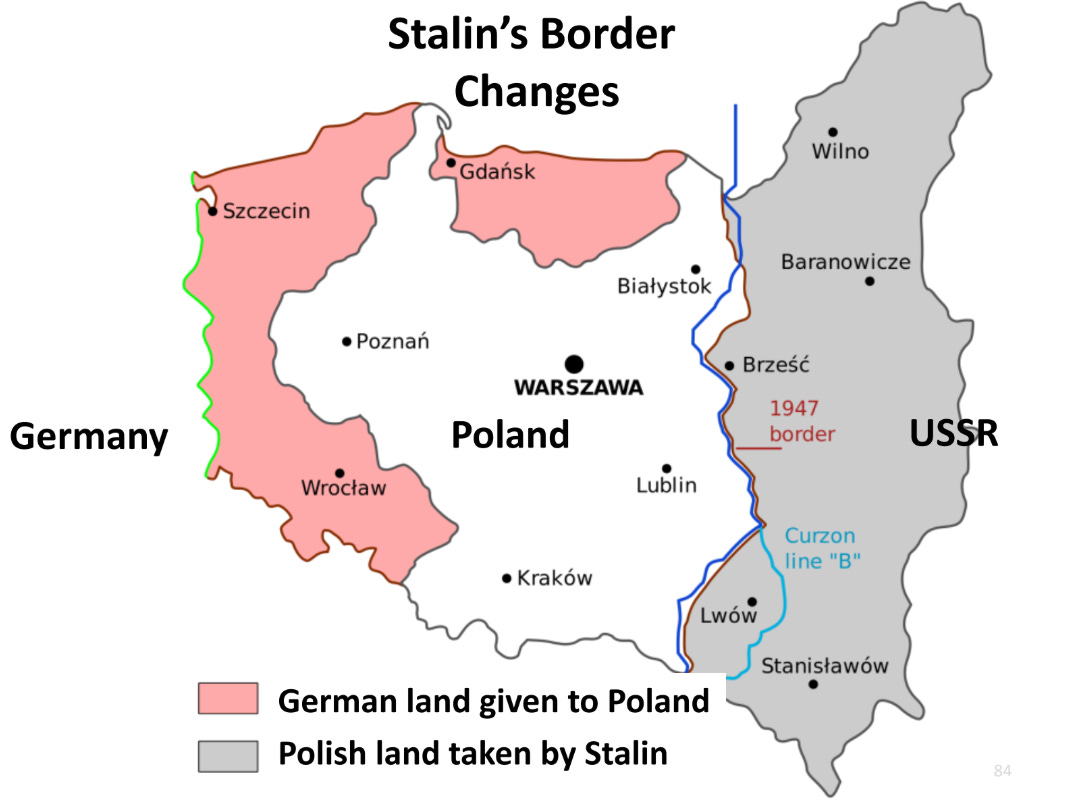
So the unification happens in mid-September 1990. Here’s the Polish borders. At the end of World War II, Stalin moved Poland 200 kilometers to the west, and it winds up taking a third of German territory by the time that’s all over. So the Germans don’t really want to sign all that away. In addition, as part of that, there were 12 million German refugees who were thrown out of wherever they were living to send them back to Germany, of whom 2 million died. So this is a big deal and it’s in living memory. Germany agrees to this, that the borders are done. German-Polish borders are set.
00:48:31 – The Gulf War and the Cold War endgame
Complicating factor: a month and a half before this unification treaty is signed, Saddam Hussein decides he’s going to invade Kuwait because he’s broke. He’s had a long war with Iran, huge debts, many owed to Kuwait, which he doesn’t want to pay back. So if you invade them, that solves that problem. Also, he would take over Kuwait’s very rich oil fields, and together that would make Iraq probably the swing producer of oil. So he thinks that’s a great idea.
Except the Cold War’s over actually. The Russians are more than willing to cooperate with the United States. Gorbachev really needs more money, and he is willing to go along with getting Iraq out of Kuwait, but not with regime change in Iraq. Because think about it, Iraq is a very important debtor state to the Soviet Union. It owed them between $10–13 billion. That’s a lot of money for a broke creditor.
But Gorbachev is being extraordinarily cooperative with Bush Sr. He sends Yevgeny Primakov on multiple missions to Baghdad. The first one, Primakov gets all Russian hostages out of Iraq. Then on the second trip, he gets all Westerners out, Americans included. Third trip, not so lucky. He’s there for the coalition force bombing. I don’t think he liked that very much. But imagine that bombing going on if there were Western human shields going down with every target. Russia took that card right off the table.
Here’s some of the reasoning. Sergei Tarasenko was an aide to Foreign Minister Shevardnadze, and they understood that the United States was going to do something about this invasion of Kuwait. So the Russians thought, “It’ll be better if we force all of this to go through the UN, where Russia has a veto power.” He said, “Look, there was a division of roles.” It extends to China, the help that Russia provided. “When the Americans asked us to work with the Chinese, we told the Chinese, ‘Think about it. You’re one of the big five with veto power. Doesn’t it suit your interest to funnel everything through the UN where you can put your foot down?’ And the Chinese came around to that idea.”
However, the Russians had red lines. Here’s Anatoly Kovalev again, the deputy foreign minister. The red line is, American troops stay out of Iraq. No regime change in Iraq. You do that and you will tank the termination of the Cold War. And that would be the goal. Here’s Kovalev saying, “I advanced the basic principle that we must support the territorial integrity of Iraq. This was our sacred position. We must not permit a division of Iraq.”
So if you wonder why the ground war ended after 100 hours, this is it. The big thing out there is war termination of the Cold War. That’s the big thing. Saddam Hussein is a minor event over there. Sorry, but he was. If it had tanked Cold War termination or upset the reunification of Germany, France and Britain might have been very happy, because François Mitterrand, who is the president of France, and Margaret Thatcher, prime minister of Britain, were against German unification. They knew it would marginalize their own country. Germany’s going to be a bigger economy, which it is.
François Mitterrand eventually found solace in expanding the European Community to the European Union when you’re incorporating all these Eastern Bloc countries into it. He plays a really important role in concluding the Maastricht Treaty that forms the European Union. But Margaret Thatcher just plain lost. She was just upset about the whole thing. She said, “Germany will be the Japan of Europe and worse than Japan.” I guess she hadn’t been to Japan lately. She said, “The Germans will get in peace what Hitler couldn’t get in war.” She wanted to leave Red Army troops in Germany for the duration. Imagine if that had been the case and now dealing with Putin… If he had troops in Germany, we would be in trouble.
But Bush and Kohl worked around all of them. Bush said to Kohl at the end of it, “Look, I’m not going to beat my chest and dance on the Berlin Wall.” Both of them were very careful never to humiliate Gorbachev about the Soviet loss of the Cold War. Why? Because they knew that if they did that, he might fall from power sooner rather than later. Also, they were afraid that if they did that, the hardliners would come to power much more rapidly than they actually did. It was 20 years before Putin started consolidating his power.
The newly independent countries of Eastern Europe needed those 20 years to integrate militarily, politically, economically with the West so that the cement could set before you got the Russians trying to destabilize them. So they bought them 20 years to do this. But there’s a cost to all this. Bush never got credit for his essential role in ending the Cold War on Western terms. So he was not reelected for a second term.
Anyway, when it came time for Nobel Prizes and why the Cold War ended, Anatoly Adamishin, this Soviet Foreign Service officer, said, “Look, it’s difficult to deny the Soviet Union was the one that ended the Cold War.” And Edwin Meese, who was a counselor to Reagan and also his attorney general, said, “Look, the Cold War began because of Soviet policies and it ended in a sense because of Soviet policies.” The Nobel Prize Committee agreed. They awarded the prize to Gorbachev, not to Bush, for his role in liberating Eastern Europe.
So when you’re thinking about this question of why Russia lost the Cold War, I hope you will come up with a more complicated answer than, “Well, Ronnie did it.” There are probably other causes at work as well. Anyway, thank you for your attention. That’s what I have for you this evening.
00:56:10 – How central planning survived so long
Dwarkesh Patel
Sarah, thank you so much for doing these.
Sarah Paine
Thank you for having me. That would be the more important thing.
Dwarkesh Patel
There’s an interesting question of why the Soviet Union collapsed when it did. I think the even more interesting question is why a system that was so centrally planned, monstrously inefficient, brutal, a colonial land empire, how such a country could survive for so long into the 20th century. I feel like that’s the thing that actually needs explanation. How did this regime last for 74 years?
Sarah Paine
There are loads of dysfunctional places all over the planet that have been dysfunctional forever. You look at well, why are they dysfunctional? To me, the answer to that one in a way is the example of North Korea. Of all countries that should fall, a place that has ongoing famines in the 21st century, and it used to be the richest part of the Korean Peninsula.
These authoritarian regimes are really good at maintaining coercive powers. Think about it. In order to educate someone, it takes years as a parent to bring up a little person and then you get them educated and maybe they’re an A-list politician. It takes seconds to assassinate them. It’s the asymmetry between construction and destruction. Destruction is so easy. Dictatorships are all over the world. It’s a sad part of the human condition. They clearly know what they’re up to.
In the case of the Soviet Union, there were multiple intelligence organizations. That’s what Stalin was using to keep track of everyone. So you want to monopolize information so that you know more information than other people. And then they have a whole bunch of people who are the winners of the nomenklatura, the elites there. You make sure you pay all of them off. I mean think about it. Human societies, slaves, serfs… We humans have been doing these things to each other for a long time.
Dwarkesh Patel
So dictatorships can certainly sustain themselves for a long time. But the Soviet Union was special in that by the 60s and 70s, they had a GNP that’s 60% of America’s, this incredibly dynamic economy. In the 40s and 50s, they had much higher growth rates, so much so that prominent economists like Paul Samuelson are saying that by the 90s, based on what they’re seeing at the time, the Soviet Union will have a bigger economy than America.
This is just quite surprising that they would have such high growth rates. If you just think about how central planning works, people are going to tell you how much steel you can make and which company gets to use the cotton fabric and cement, etc. You have hundreds of millions of people living under this system. It’s actually quite shocking that they actually had notable growth rates after World War II for decades on end.
Sarah Paine
Well, first of all, it’s a war economy, essentially. You’re putting all your money into having a big military. Russians define greatness—this is part of it—as being a big power, and its a military power with territory. Most countries in wartime mobilize for the military. This country did it in World War II. All kinds of rationing, we’re not using market prices. You’re setting different prices, giving people ration cards and things. The thing about the Soviets is they kept it forever. They never got rid of it. So that’s one piece.
Another problem with the Soviet Union is all of the data. So I don’t know what data you’ve seen, and I know the data I’ve seen. It’s hard to know because the Ruble is a non-convertible currency and a lot of things they measured in weight and other things. Like they’re the greatest TV producer in the world, they said. Why? Because they made the heaviest TVs in the world. I’m serious, when I was there this was it. They would spontaneously combust, which is not the normal thing a TV should do for you, burn down the apartment building.
So they’re going to measure their heavy TVs as a positive, and the Ruble is non-convertible. So there was a guy named Murray Feshbach, and I can’t remember which part of the US government he was in, but he was really good at looking at their statistics and then adjusting them. But people didn’t know. I gave you the CIA ones. The CIA, they’re not stupid people. They’ve got the best data they could find and they’re coming up with 20% of the Soviet budget is probably devoted to the military. After the Cold War is over, they’re going, “Whoops, we missed.” It’s at least double that and maybe triple. So it’s really hard to know even with the statistics you’re getting. Certainly what Paul Samuelson had wouldn’t be accurate. It’s just a guess.
Dwarkesh Patel
My favorite example of this is that there were top-down commands that you had to produce a certain amount of steel. A steel factory would then be incentivized to make thicker bars of steel rather than thinner bars because that would count as greater production, except a lot of inputs actually do require the thinner sheets. So then the other factories have to thin down the steel, but that also counts towards GDP. So producing the inefficient steel and then cutting it down to size is both being double-counted towards GDP.
Sarah Paine
Oh, and just the whole waste of it. Like the heavy TVs, they probably have four times the inputs that they need to make them that would be good for other things. It’s this notion that you can actually plan an economy. Prices are a miracle. Good old Adam Smith, the invisible hand. Prices are the way to go and markets, it’s more efficient.
Dwarkesh Patel
I wonder if one thing that’s going on is that in the early and mid-20th century, you have economies which are much simpler, at least compared to today. So even then, obviously, command and control is less workable than capitalism. But if you just have heavy industry, you need a certain amount of cement, steel, concrete, fabrics, coal. That’s much more workable than, “We’ve got to centrally command what SaaS tools your enterprise is allowed to use.”
Sarah Paine
Oh, yeah. It’s interesting on the development thing. The communists have insisted on heavy industry. That’s the thing that they want. Forget about the consumer goods. If you look at the countries that really have made it, like Japan and the Meiji Restoration, they’re doing a lot of light industry and consumer goods. Then they move into heavy, but they’ve already got people on bicycles and they’ve got textiles and other things up and running.
That would also apply to Taiwan and Korea. They do, by all means, get heavy industry. But that’s not the starter program. The starter program is basic standard of living. Again I’m not an economist, but it turns out if you just look at who’s rich and who’s not, that seems to me a more workable thing.
Dwarkesh Patel
There’s also the fact that the centralized regime is building things according to the 30s plan. And even after post-war reconstruction, they’re still calling back on these plans from the 30s that call for heavy industry for a bygone era.
In the 70s, 80s, we had our rust belt collapse of manufacturing. People complain about this as, “Look, the US has this hollowed-out manufacturing base.” But it’s much better to have industries which are left behind so that the whole economy as a whole can be more dynamic and move on than the Soviet Union where the entire thing became a rust belt because they couldn’t move on.
Sarah Paine
It’s more exciting than that. Again, I’m not an economist, but apparently they missed the plastics revolution. I mean think about our own lives. Now we’re finding we have too many plastics, but plastics are an incredible material and they’re just missing that. I remember in Russia trying to figure out where to get sour cream and was being laughed at by Russians because I was so stupid in the store that I couldn’t find it. Well, we have little plastic tubs with the sour cream. Back in the late 80s, when I was there, you had to bring your glass jar with you so you could hand it over the counter so someone could take a filthy ladle and fill up your jar. I mean, this is part of not having plastics.
And then they totally missed the computer revolution. This plays into Ronald Reagan winning the military race. We’re putting these chips and things into our ballistic missiles and they can’t do that. And that’s a problem.
Dwarkesh Patel
Speaking of plastics, I didn’t realize before preparing for this lecture the overwhelming role that oil played in first explaining why the Soviet Union was able to sustain itself for so long and then why it collapsed. By the late 50s, Soviet growth rates were already starting to go down, especially compared to the postwar boom that America is experiencing. In ‘59, they discovered these massive oil fields in Siberia.
And then from 1973 to 1985, I think, 80% of the Soviet Union’s hard currency earnings were just from oil. They use this because central planning can’t produce even grain, let alone advanced technology. They use this to import a bunch of stuff to sustain the Red Army, to sustain the population, to subsidize Eastern Europe. And then of course, prices collapsed in 1985. Do you think that if the Siberian reserves weren’t found in the late 50s, that it’s possible that the Soviet Union would have collapsed 30 years prior?
Sarah Paine
I don’t know, but they wouldn’t have been able to do all the Africa program and things. It just would be too expensive. So certainly it would have been a reduced thing. It’s also the gas reserves they got up in like the north central Soviet Union. I can’t remember the places, but this is the gas that gets pumped to Europe because that’s the better place. They make those big investments and it takes a while for them to pay off. That was a big deal because they needed help from Western oil companies or whoever does the gas pipelines, compressors, whatever it is you need. There was a big to-do about that, about whether we should sell the stuff or whether we shouldn’t sell the stuff. The Europeans wanted to sell. We were trying not to. This was going on under Reagan as well.
But anyway, they had built a lot of it and it was essential to their pocket change. But then when they got all the pocket change, they never saved. Whatever the oil wealth was, they spent up to the max. Doesn’t it sound familiar? Governments, you have money, you spend it. Forget about rainy days.
Dwarkesh Patel
So after the Soviet Union collapses, there was a period when Putin was still winning somewhat free elections. So if you look at why Russia’s economy recovers and why Putin was so popular in the 2000s, from 2000 to 2008, oil goes from $10 a barrel to $140 a barrel. This goes to your point about how we give credit or blame to political leaders for often what are just long-run macro trends.
Sarah Paine
Well, what I didn’t cover is that when the Soviet Union collapses, Soviet living standards, Russian living standards, they implode and it’s a mess for 20 years. It is just unbelievably difficult.
Oh, and another piece of the brilliant Soviet management: in order to maintain control over the empire, instead of building things all in one place, you build some plane parts here, some plane parts there, some plane parts all over the empire. So when the empire goes, great, I’ve got a quarter of a plane, and then where do I get the other parts? So all of that fell apart.
When Putin suddenly has a lot of money he starts spending it on people, because initially there’s plenty of money. Russian standards of living do go up. So of course they like him, and they give him credit for all of that. But then that runs its course, right? And then it’s less good and then he’s more excited about… Well, it’s his mindset anyway. When you get more money, you want to get the empire back. And then Russians also like that, right?
Dwarkesh Patel
Speaking of the empire, Russia’s economy just had this terrible period after the collapse of the Soviet Union. A lot of the Eastern European satellites seem to recover in this gangbusters way. Obviously, East Germany. But even Poland today is such a big success story. What’s going wrong with the mainland itself that these other countries are able to recover from communism much better?
Sarah Paine
Well, they had always been much more connected to Western Europe. Czechoslovakia before the war was a full-up highly developed country absolutely tied to the West. Poland, I believe, Copernicus is from a place like Poland, right? It’s a center of the Enlightenment.
But when I was using the George Bush Sr. archives, it’s fascinating. So it’s ‘88, ‘89 when the Soviet Union’s imploding. There’s a lot of correspondence between Eastern European, particularly Polish, leaders coming to the Bush administration saying, “Hey, our banking system, we know it’s a mess. Our financial system’s a mess. We know we need expertise to help us figure out what our legal system is going to look like.” And Bush is all over that. I’m sure he farmed them out to the private sector who would also be all over that, like giving them free consulting. So as a result, you do have them really taking advantage of this 20 years.
At the same time when Bush would have loved to have given some of the same advice… There were people like Jeffrey Sachs and others who went to the Soviet Union, but it was not remotely the same thing. This is people throughout Polish society requesting this advice, not like one guy with an office in Moscow. Basically, the Russians thought they knew it all and they thought they understood. This is all the unknown unknowns, the things you don’t understand, your blind spots. Truly, economics is a blind spot for the Soviets.
Because think about it, when the tsars ran the show, it’s like a riff off the Mongol Empire. You take cuts from people’s businesses, from trade that comes through. Then it’s also about selling basic commodities. You’re not thinking, under the tsars, of Russia doing high-end manufacturing. I mean, I guess Fabergé and some jewelry if you want to do that. But really that’s not it. It doesn’t have this commercial tradition, being tied into this commercial tradition of Western Europe and all the sea routes for trade.
Then when you get the communists, they aren’t about that at all. So there’s really a dearth of knowledge. Think about this country with all the little kids selling lemonade, right? You see them on the streets. They’re already learning. The kids who are doing newspaper routes, they’re already learning about buying things, selling things at a very young age. We just take this knowledge for granted. It was just absent in the Soviet Union and not as much absent in Eastern Europe that had been more connected in.
Dwarkesh Patel
Before we get to the period of Russian collapse, let’s go back to the end of the Soviet period. Gorbachev starts instituting these economic reforms along with glasnost and perestroika. But what I find mysterious is that those economic reforms not only fail to prevent the stagnation that the Soviet Union is experiencing, but they in fact make things worse.
You would think that reform, even if it’s handled badly, would have some sort of positive impact. If you do it badly, then it’ll have a smaller positive impact. But here it just causes this huge hyperinflation, causes all these big problems. So why did reform have this backwards impact?
Sarah Paine
There’s so much that needs reforming there. But part of it, I think, is because he wanted to do political reforms. That’s what he understands. As a human being, that would be the thing that he’s very familiar with. Think about it. He’s an A-list member of the Communist Party to be the guy when they do generational change, he’s the one. So he’s obviously very astute at that level, but the problem is economics. He’s giving away political power before he’s fixed the economic problems. China’s conclusion is there is no way you’re going to touch political power. They’re going to hang onto that and then deal with as much of the economics as they’re going to deal with. That’s part of it.
But part of it is there’s no tradition for all of these things. Then you go, “Well, how did Russia get this way?” It’s a very difficult address. Prior to the Industrial Revolution, it’s flat, neighbors all invade, and so you needed a big army in order to defeat them. A big army is going to want a war economy. Historically, you’re going to want to support a big land force. I mean this is my take. Others who are actually experts on these various periods of Russian history can come up with something else. But I think you’re funneling, you’re channeling your economics into that.
Whereas you’re looking at Europe, particularly Britain, and it’s merchants. They have a big aristocracy who are not going to dirty themselves with buying and selling stuff, but there are a tremendous number of very rich merchants in Britain that are going to influence government laws and things, which is not going to take place in Russia. Then what’s nice about the Navy for Britain is you send them away. They’re not going to run a coup in the capital because they’re off on the ship somewhere. And there aren’t that many of them compared to a standing army. So I suspect, I can’t prove this, that this leads to different outcomes or contributes to them.
Dwarkesh Patel
One theory I heard that is complementary to your theory is that Gorbachev is instituting reforms because he thinks there should be decentralization and democratization, but he doesn’t fundamentally believe in the market system. So he’s delegating power to these quasi-firms. At the same time, he thinks the price system is immoral, private property is immoral. So they can’t intermediate between themselves using real prices.
So then how do these firms intermediate? Well, there’s corruption. If you can’t use actual prices and property to figure out who gets what allocation of scarce resources, you just backroom deal, which makes the problem worse.
Sarah Paine
Well there’s no legal system and you need a legal system. Legal systems take a long time to develop. So you’re telling the Soviet Union, “Okay, communism is down and now chop chop, we need a new legal system.” It’s not going to happen.
01:14:46 – Sarah’s life in the USSR in 1988
Dwarkesh Patel
You were mentioning the problem that Eastern European countries especially had, which is that they’re going more and more into debt because they’re not able to produce globally competitive exports. They have this last-ditch effort that “We’re going to solve our problems with some technological miracle. We need to get even more over-leveraged. We’ll get some Western machinery or technology, and then we’ll be able to finally produce something that the world wants.” I’m curious up to what point this was a plausible hope. Through the 80s and even till the end of the 80s, they still believed that Czechoslovakia or East Germany or something could catch up with West Europe?
Sarah Paine
They’re desperate. Think about it. If you’re a communist leader, how many other cards are there to play? You’re looking, “Okay, this is the only card I got.” And they’re doing other things because of the social unrest. They want to import food and consumer products because they’ve been so neglected.
Then there’s another piece, which is VCRs, the videos. All of a sudden, those things came around. I remember being in the Soviet Union, the academic year of 1988-89. One of my classmates had been an English language tutor of this person in Moscow and set me up because that was the only way to get a good meal once a week. For a meal, I would talk English for an hour.
What that family wanted more than anything else was a VCR player. You could have hard currency and buy it at the diplomatic store. So I basically got them a VCR by going to the diplomatic thing with my very limited foreign currency. I bought an overpriced VCR for them and got all kinds of meals for the rest of the year. But it meant that they could all of a sudden get Western movies.
There are things in movies where there’ll be a picture of a fugitive running by the fruit section of the Berkeley Bowl. The Russians would gasp like, “Oh.” It’s unbelievable. I think that Raisa Gorbachev, Gorbachev’s wife, when she came and visited, she must have realized that a welfare mother on food stamps had better buying power than she did by just being able to have access to Walmart.
I think the elites, as they’re traveling… I have no statistical data on this, but as you travel, it’s like I’m comparing me getting sour cream in a jar. That was the other thing, counting up all the things in a Soviet supermarket. The total was something like 77 items total in this supermarket. I don’t think that compares favorably to a candy rack as you leave a 7-Eleven. And when you went by the meat section, the smell just about knocked you out, rotten meat. It was really disgusting.
I got really good at making borscht. Go to the peasant market, pay hard currency for bones, because I couldn’t afford any meat, but I could afford the bones. Then I would buy… The Russians produce really good sugar beets so I got beets. Then you’re starting to get rotten apples over the winter, but they at least come from Hungary. Russians didn’t even produce apples in those days, but Hungarians did. The Romanians provided the canned tomatoes, and I could do a credible borscht.
But you’re talking about Moscow, the center of everything. I remember buying potatoes at the market and the rotten spots felt gelatinous. So you’d have to cut those out. And then you’re wondering how many nutrients are in the rest of that potato. It was a really gross year. I remember going to the candy store and I would buy caramel from Poland or somewhere. It was like a food item because it was actually edible.
Dwarkesh Patel
At this point, I bet you were wondering why you didn’t write a biography of Napoleon so you could just visit Paris instead.
Sarah Paine
My brother’s comment is, “You’re studying Russia and China, two countries in the breakdown lane.”
Dwarkesh Patel
By the way, the point about the grocery stores having 74 items is interesting in two ways. One, central control works much better if you have a much smaller amount of items to optimize over. So if things are standardized, it can work much better. And second, to your point about GDP being hard to compare between the Soviets and the United States, how do you compare a rotten tomato or a rotten potato to the Idaho ones that you can get?
Sarah Paine
They would have compared it by pound.
Dwarkesh Patel
Exactly.
Sarah Paine
Yeah.
Dwarkesh Patel
You said you were there in ‘88 and ‘89. So this is before the Berlin Wall has fallen.
Sarah Paine
I was watching the Tiananmen demonstrations on Soviet TV. The only reason you got that TV coverage is because Gorbachev was in Beijing. So all the press was there. That’s why you have the coverage. And they stayed on because the students were demonstrating and the Chinese closed society wasn’t aware of the power of television. Guys, they’re going to film you doing all of this stuff and they will get the film out.
Dwarkesh Patel
In ‘88, was the mood… Obviously things are going terribly, but did people realize that they’re only two years away, or three years away from the complete dissolution of the Soviet Union?
Sarah Paine
No. Maybe the end of the Soviet Union, but there was such optimism of thinking we’re finally going to be a full-up democratic country. It’s going to be wonderful, with no sense of the work schedules that go into a capitalist economy. To create the wealth in this country, a lot of people are working far more than 40 hours a week, particularly as they’re getting started, working enormous hours.
That was not something that was in most people’s minds. Sure, the kids who became the ballerinas in the Bolshoi are working long hours to do that. But as an economy as a whole, they didn’t understand the source of wealth and had no inkling of all the things that are missing, not least of which is that no one’s got the right education. Great, you got Marx memorized. That does you zero good.
Dwarkesh Patel
So around this time is when people are finally learning about what actually happened during the Stalinist period.
Sarah Paine
Oh, yeah.
Dwarkesh Patel
So people are optimistic that we can have a changing of the guard and maybe things will improve. But at the same time, they’re learning about how terrible their history actually was. Between these two things… Also at some point they must realize through the 90s that things actually aren’t improving. In fact, they’re getting worse. So what is the inflection point at which the mood is just...
Sarah Paine
I don’t know, because I wasn’t living there. I was thinking that there would be impending problems as a Chicken Little American. The sky is falling, the sky is falling. Americans always think disaster is coming. I sort of fit in that crowd. But I think there was a lot of optimism and exuberance thinking, “We have the freedom to really understand our history and what’s happening.”
This is for educated people, people with college degrees in Moscow and St. Petersburg. Now what’s going on in the rest of the country is undoubtedly a different story because as bad as living in Moscow was, living in the countryside was going back in time far further. So those people weren’t living well at all. And it’s going to get really bad for them.
Dwarkesh Patel
Okay, so people are learning about these things for the first time. Is the sense that they kind of suspected? I mean, people have family. They must have known, “My uncle was off in this little mining town that he was forced to go to for a decade right after World War II.” Were they totally shocked or was there some sense that things were pretty bad and now we’re just learning the extent of it?
Sarah Paine
I think there was an understanding it was terrible, but I think there’s this exuberance of thinking it’s going to get much better. Then the disappointment is equally extreme. And then there was this feeling that the West owes us because you’re all really rich and you now owe us to fix everything. The counterargument to that is, “No you are an enormous migraine. You set back all of these countries across the globe in time with this nonfunctioning communist model that you peddled around there. And now you want extra aid.”
The problem was that we wanted to do some of the aid, but they’re not going to be receptive to it. That was another conclusion with the Bush administration, that if we dumped a lot of money in it, it would just go straight into corruption. You need a legal structure in order to place money, and they just plain didn’t have it. That was another thing that was worrying the Bush administration. There’s nowhere to put the money.
Dwarkesh Patel
Speaking of these different countries that the Soviets and the United States were competing for during the Cold War, you had this presentation where you say Reagan alone didn’t do this. But I wonder if the broader lesson is that nothing any US president did in terms of foreign policy… That was all a sideshow, this tête-à-tête competition for different Third World countries: “We’re going to get Brazil, we’re going to get Vietnam, we’re going to get Algeria.” That just seems much less significant than the fact that liberal capitalism was more appealing and out-produced communism. So even if some country, even if Brazil goes communist, this is not going to change the fundamental playing board here.
Sarah Paine
If you do not protect the liberal economies of Europe, you’re not going to have anywhere to play the liberal economic game, and also Japan. One of the reasons you feel that liberal economies work is you’ve got economic miracles going on in Japan, Korea, Taiwan, Singapore, and Hong Kong back in the day. So if you abandon those places...
Also in the Cold War, there was a tremendous amount of economic growth across the world, particularly in the Third World. Why? Because in the past, if there’s a civil war, whoever’s losing either comes to us or comes to the Russians and says, “Help us.” So whoever it is helps, and then the other side feels obliged to help, and then you’re just destroying wealth ever more rapidly. The Cold War was anything but cold in the Third World. Tens of millions of people died in these conflicts. So when you end that, all of a sudden they can start compounding growth.
So there is a problem with not countering someone who’s going to impose communist systems all over the place. Communist systems are really good at putting dictators into power in a civil war situation. It’s very effective. That’s how Mao gets into power. The problem is, then they win the civil war, they’re in power, they annihilate the opposition, but then it produces compounding poverty thereafter.
Dwarkesh Patel
So there is this conundrum, and I genuinely don’t know the answer to this. In order to beat off these communist factions and guerrillas, we often through the Cold War had to support other dictators. Probably in many cases they were better than the communist alternative. It’s just very hard to beat Pol Pot and Mao in terms of how terrible you can be. But obviously this was in its own way problematic. Even if we didn’t have to support dictators, we had to alienate countries.
You had this previous lecture that you gave on the Indo-Pakistani chapter in history where we had to alienate India in order to fend off against the Soviet Union in this little episode. I don’t know what the solution to this is. If you think that this theater mattered less, then you could say we should have just kept our hands clean of these different Third World countries. But to your point, if you want to be able to show that these countries are going to experience growth under capitalism, then you want them to not be under the subjugation of communists. But then you have to support sometimes objectionable regimes.
Sarah Paine
I think you had a more optimistic generation, ironically, optimistic. The people who had survived World War II, there was a real generosity. American servicemen and women were welcomed all over Europe and they were adored in Europe. They came back and they were a very generous group of people. Others felt generous to them.
That’s when the GI Bill just passed saying, “You’ve saved everyone. Therefore we’re going to give you college educations, extend home loans to you.” Not to African Americans, they were excluded from this, which is a problem. But white Americans weren’t. It led to massive economic growth where people who’d never had a college education in their family, they did. All of a sudden, instead of having really hard manual labor, this real optimism. And then it extended to foreign countries. This is when this country was tremendously generous to others, and it worked very well for us.
Think about the Marshall Plan. It looks really generous putting all this money into Europe. We made a fortune off of it, as did Europe. If you’re smart, you’re looking for win-wins of things where you both benefit because that’ll incentivize the other side to join in. This is basic strategy. This is one of the reasons I’ve got problems with the United States’ turn to zero-sum approaches where “I’m going to get everything, you get nothing. Then I look so smart when we do the clickbait on this moment where I get everything and you get nothing.” It’s much smarter.
The other piece is that a lot of things don’t pay off immediately. George Bush is not reelected president. He absolutely deserved to be. Because what he did, the payoff was huge, ending the Cold War on Western terms. But it doesn’t pay off in time for the next election. I think this is where Americans miss it. You’re looking at what someone does on a given day when the real implications are what’s going to happen in a decade. Like on tax policy, if we keep racking up our debt, it may get us out of the corner today, but is it going to back us into a corner later on? This is where Americans need to think a little harder about long-term implications of things.
Dwarkesh Patel
I thought when you pointed out that it would cost 60 billion Deutschmarks for West Germany to pay Gorbachev to let East Germany join West Germany. That’s a lot of money. But if you think about decades and decades of future growth, it’s a huge bargain. It’s a mistake to think about how expensive things seem at the moment. It’s another huge country that you’ve turned.
Sarah Paine
There’s a statement that politicians think of the next election, statesmen think of the next generation. George Bush and Helmut Kohl are statesmen. They’re thinking of the next generation. The group that fought World War II, many of US and allied leaders, were statespeople. They’re thinking of the next generation. Or if you’re thinking of where I’ve got Mitterrand, who’s negotiating the Maastricht Treaty about the European Union, that is statesperson’s work of what’s the next generation. It’s important. We need more statesmen, statespeople, political leaders.
Dwarkesh Patel
To try out a different thesis on you, through this period the Soviet Union is also trying to buy off other countries, especially when it thinks its economy can grow. Especially when oil, after the 1973 oil crisis, oil prices just skyrocket. This is why some Soviet citizens remember the Brezhnev era favorably. Oil made it possible for the Soviets to not only import stuff, but through the Brezhnev period there’s actually a net export of resources to Eastern European satellites rather than the other way around.
Sarah Paine
That’s probably their data. I get it, their oil is really subsidized, but everything in the Soviet Union that was worth having came from somewhere else. The problem is how do you measure it? They’re just going to measure by weight or something else. It doesn’t really capture what they’re getting.
Dwarkesh Patel
The larger question being that, it’s not like the Soviet Union didn’t think of doing things like the Marshall Plan. Obviously nothing to that extent, but this idea that you can win people’s favors by providing them military aid, providing them foreign aid. They just didn’t have the resources to do it to the extent that the US could.
Sarah Paine
That’s true, but there’s a real coercive piece too. If you mess with them, it’ll be really ugly.
Dwarkesh Patel
Here’s what I don’t understand about the arms buildup during the Cold War. The Soviet Union is spending 2% of their GDP just on nuclear weapons alone at its peak. Arms control advocates will make this quip, which is that we’ve already got enough weapons to destroy the world many times over. Why do we need more? But that is sort of an interesting question. What was the point of spending so much of GDP on the marginal nuclear weapon or marginal weapon system?
Sarah Paine
I don’t know the answer, but you read the plans about these things and you wonder what people are thinking. We were trying to develop tactical nukes. There was only a little trick with that. Whoever deployed it would be within the blast range of the tactical nuke. You’re going, “Who develops a weapon like that?” Apparently we did. Luckily we didn’t deploy it.
I don’t know the answer of why we had such massive redundancy in these nuclear weapons, why the arsenals were so massive. I don’t know the story on how you maintain these things and how long they last. It doesn’t make much more sense to me than it does to you.
Dwarkesh Patel
Another question. Sino-Soviet split, this huge diplomatic coup. The Soviets had to put a million soldiers on the Siberian front against China. They had to spend 2% of GDP just stationing and garrisoning this area, which is obviously a lot. That’s often what many countries spend on defense as a whole, let alone just along one front.
At the same time, 2% GDP, well if they just had one or two more years of extra economic growth or faster growth, that could make up for this huge diplomatic coup. Again this goes back to the point of, if some domestic policy just caused slightly higher economic growth rates, that would make up for the biggest diplomatic coup of the entire Cold War. It goes back to economy first, diplomacy second.
Sarah Paine
Firstly, I have real problems with the statistics. I got a sample size of one, moi. I remember living in Moscow. It was so backwards. It’s just breathtakingly backwards in just about every way imaginable. They got a big fancy subway system that looks remarkably retro, and at least it works. But the consumer goods were so awful, the quality was so bad. You look at the buildings themselves.
I get it, they make nuclear weapons. Do they make anything else? Their cars were a joke, their Ladas or whatever they were. It’s just thing after thing. So you’re looking at all their stats because that’s what they are telling you, that we’re so great. It really is an Emperor Wears No Clothes moment that finally the little kid goes, “Oh, you’re actually naked.”
I can give you an example. These acquaintances in Moscow were talking about hospitals outside of Moscow that some of them didn’t have running water. How do you have a hospital without running water? I don’t even know how that’s even conceivable. Or when their kid had put her hand through a glass door or something. They wanted to get her stitched up because she’s bleeding. She’s not going to die, but she’s probably bleeding all over the place. They bring her to one place and, oh, they got no thread to do the stitches. So then they have to go to another place. Who runs a country like this?
Dwarkesh Patel
Alright, you convinced me. BART is acceptable. I’ll stick here. Subway’s not a big deal. I don’t want to move to Moscow.
Okay, while the Eastern European satellites are trying to leave the Soviet Union, this has happened many times through the 20th century. Hungary in 1956, Czechoslovakia in ‘68, Poland through Solidarity. Every previous time there’s a many-million-person-strong Red Army stationed in Eastern Europe left over from World War II, which rolls in the tanks and prevents these revolutions from taking place.
So what happens in the late 80s and early 90s? The Red Army is still there. There’s still millions of Red Army soldiers. They just don’t shoot.
Sarah Paine
Generational change. The leaders don’t have the stomach for it anymore. I don’t know how you’d feel about sending tanks and going, “Oh, we’re going to splatter all these people.” I think for many Americans, that would not be the choice that they would make. So this ruthless generation is gone.
Another piece is that Gorbachev had traveled and I think he had some Czech friends. I can’t remember all of his lists of friends. But they’d been horrified by Czechoslovakia in 1968 as young people watching, as Russian young people watching it and thinking, “It’s just wrong. We shouldn’t be doing this. If communism is what it should be, this is not what should be happening.”
This is of their youth. Gorbachev and his generation. It’s not just him, he reflects a whole generation of communists. They’re thinking, “There’s got to be another way. This is just not right.” So he thinks he’s got his other way. It’s this exuberance of the reforms and things that are happening in Russia. There’s a tremendous feeling of energy. He’s telling the Poles, “You get at it too. We’re all going to do this thing.” But it’s all the expertise and things that he’s missing, that he’s unaware that he’s missing, as are all these other people, because how could they have it? They’ve been living in a command economy.
Dwarkesh Patel
This is what I wanted to ask you about. You had the de Tocqueville quote about how revolutions happen when governments start to institute some kind of reform. Gorbachev is doing perestroika, glasnost. There’s the conservative reactionary parts of the Communist Party, which by the way is a phrase I wouldn’t expect to have said. But they’re trying to resist this. So Gorbachev goes about dismantling the party secretariat and instead devolving power down to the individual republics. We know what happens later. These republics are saying, “Look, we want our own country now.”
But this raises a question. If you do inherit a brutal regime, and now you say, “I want to do reforms.” You know this dynamic that de Tocqueville pointed out, which is that as soon as you start reforms, actually what tends to happen is that you lose power, not that people consolidate it under you. What actually should you do? Because you’re like, “I want to improve people’s lives.” But as soon as you try to do that, the whole thing’s going to fall apart.
Sarah Paine
This is so far above my pay grade. I’m a professor. I have trouble justifying a B+ on a paper. I’m a believer in gradual reforms. Do it incrementally. For the Soviet Union, it would be gradual legal reforms, work it through their Duma slowly, and do it that way. But seek out help from the European Union that has many, many experts that would be overjoyed if Putin and friends would cease doing their number on Ukraine. Now the problem is you’re going to get into reparations for the horrors they’ve inflicted. So that ship has sadly sailed for this generation. There’s no nice ending for Russians. It’s too late.
But you can look at Europe itself improving its institutions and Ukraine improving its institutions. If you think about what forces you to change, the existential threat on Ukraine, if they survive all this, this is forcing them really to clean up their institutions. So it’s happening rapidly there, but we don’t know the end of that story, how it ends.
Dwarkesh Patel
I do think these are interesting lessons here of whenever we look at a country from the outside, we have this thing of, “Well, just reform everything and just fix your economy.” Whenever we understand the system better… For example, in the United States, healthcare is 20% of GDP. This idea that Trump or Obama or Biden, whoever, could just come in and be like, “Well, I’ll just fix healthcare.” We recognize that this is a wildly implausible thing to happen. But then we have this expectation that in Russia, Gorbachev or Yeltsin could have just been like, “100% of my economy is messed up, and I’m just going to fix it.”
Sarah Paine
American hubris in action. Think about our country. We have one of the most crazy tax codes on the planet, and neither party can touch it. Because you touch any part of it, someone negotiated that wording exactly. Yet think of how much of our economy is taken up by the overhead of all the tax accountants, all the misdirected cash in order to take advantage of something that’s simply an invention of the tax system.
There was years ago when there was talk of doing a flat tax, “Wouldn’t that be much more efficient?” You can imagine what accountants thought about that one. That idea has totally died. Talk about inefficiency. Then we realize we have budgetary problems in this country. This would seem to be something that ought to be on people’s radar, clean up the tax code. But isn’t it precisely that many people don’t want the radar on the tax code? That’s why we’re wondering who can get in and out of girls’ or boys’ bathrooms, instead of looking at the tax code, which should be the real thing.
Dwarkesh Patel
I think there should be big deductions for podcasts. It should count for research and development.
Sarah Paine
Well, Dwarkesh, you’re almost at that stage. You need to add a lobbyist in DC.
Dwarkesh Patel
We’ll work on it.
There’s a very interesting book about North Korea, I forget the title, where the author is pointing out that North Korea could not even start doing reforms today because as soon as there was some sort of information from the outside world that North Koreans could see—which would be part of any reform—they would immediately realize that everything the government has told them is false. South Korea is enormously wealthier and they have this terrible standard of living.
Obviously, this is the same experience that Eastern Europeans had. Literally in many cases, you had a country that was bisected in half and the other half is living so much richer. In those situations, I guess this goes back to the question of, “Well, today in North Korea, how would it even kick off if Kim Jong-un just had a change of heart or if somebody else came into power?” They’re probably just trapped in this to the extent that they want to keep power.
Sarah Paine
Oh, he’s trapped because he’s a dead boy if he tries to take a go at retirement. In Asia—I don’t know exactly all of the parts of Asia where this applies to, it’s some parts—there’s a thought that things last for three generations and then it’s over. So he’s the third generation. Whether this is true or not doesn’t matter. If you believe it’s true, it will become a self-fulfilling prophecy. So I’ll be interested. I probably won’t live to see it, you in the room will, what happens to the Kim family, whether it makes it to generation four or not. But by their own belief system, in theory, they shouldn’t. So who knows?
Dwarkesh Patel
One more question about oil.
Sarah Paine
Based on my big expertise on oil, zero. Okay.
Dwarkesh Patel
During this period between ‘73 and ‘85, when they had these huge oil revenues, presumably there was some amount of exuberance. But did the government recognize and realize that they’re super fragile to the price of oil and if that collapses, they need some sort of contingency plan, some rainy day fund? You must notice that, “Oh, this is half my budget, and all of my foreign currency is coming from oil, and this is a very volatile commodity.” Nobody noticed that?
Sarah Paine
Yeah, well, it’s interesting. I was reading this long chronology that was put together sort of like early Putin. So before they really shut down all the information. It was just a chronology of the Cold War, big fat book. Just like someone like me to read a book like that. So I’m going date after date after date after date. It’s written by people who are really angry about how the Cold War turned out. One of the takeaways from the compilers of this thing is they kept criticizing. They showed how much for every year Russia was making in oil revenues. It was huge. But in their analysis it was, “And they saved none of it”, right? There was no sense of investing in something.
There’s something called consumption. There’s another thing called investment. Going around and buying a bunch of Western grain is consumption. There’s none of this being put in anything that’s going to yield anything. So that was a big criticism from the authors of this book. To the question you’re asking, “No, they just milked it while they were there.”
Dwarkesh Patel
Final question, this is not so much a question as an observation. I don’t know if you have a reaction to this. Just look at Russia’s history through the 20th century: tsarism, communism, collectivization, to more than 10% of your population dying from World War II, then back to Stalin, and then more communism, and then the economy collapses again, and then Putin. Especially if you look at the satellite states, they had all of this happen to them and worse because now they’re getting invaded.
Whereas you have other countries. Japan and Germany also had tragic histories, but then they recovered. Maybe it’s just the tragedy of Russia.
Sarah Paine
Yeah, you’re lucky you’re not Russian.
Dwarkesh Patel
Yeah, exactly.
Sarah Paine
No, it is tragic. It is tragic. It started out as a difficult address, pre-Industrial Revolution, that required certain things to survive. They were more ruthless than their neighbors. They did survive. I mean, in a previous lecture, I discussed how they wiped out entire princely states and Khanates and things, they just wiped them out. Then you’re using their elites because it’s a rough neighborhood. The problem is if you aren’t on the winning side, you’re going to be on the losing side, right?
But since the Industrial Revolution, where you can do compounded economic growth that comes from commerce and trade and industry and things, that’s the real way to get powerful because power becomes a function of your wealth. That involves having legal systems, institutions, and stability. Russia has found it very difficult getting with that program. It has to do with, I think, this very difficult historical legacy of who rises to power, and also all the missing things. They didn’t have the Renaissance, they didn’t have the Reformation, these fundamental movements that were very influential in the West.
So there’s a lot of negative space of things that didn’t happen. There’s all the awful stuff that you saw that did happen, but then they’re missing things. So it’s very difficult. Then people like Putin can set the clock way back because he’s killed so many Ukrainians. What he’s done will take a generation at minimum to get to anywhere where people are going to be thinking about… People will be talking about reparations from Russia for quite a while and they’re poor, they’re not going to want to do that.
Dwarkesh Patel
I should have thought to end on a more optimistic note, but...
Sarah Paine
Well, history’s ended, okay?
Dwarkesh Patel
Well, you’ve outlined the ways in which countries can chart a better course for themselves and that’s where the optimism can come from.
Sarah Paine
Actually, I’ve told a story about the last Cold War that stayed cold in the industrialized world, which was a good thing, because it could have been nuclear. It was tragic in many other parts of the world, but at least it stayed cold in the industrialized part. There was a strategy that a very thoughtful generation of people, not just in the United States but all over the West, put together to allow for a non-nuclear landing for the Soviet Union when it fell apart. From this, you can derive some of the strategies that worked for ending it that way. These are the kind of strategies that we’re going to have to use in order to navigate the second Cold War.
The other piece about the Cold War is the Soviet Union living miserable lives of their own making. But Americans were actually having a good time. They paid taxes, they had to pay for all the nuclear weapons. But as I recall, people are running around in Disneyland, they’re doing their European trips, they’re buying houses. So actually Americans, people in Western Europe, were living fulfilling lives while they’re waiting out for others to get with the program.
If we’re going to make it through this second one, we need to start cooperating with our allies, building institutions, and improving laws. Don’t just burn down the house. We will get through this one too, and we will live fulfilling lives while we’re waiting for Putin to come up with something different or Xi Jinping to come up with something different. But if we blow through our good hand of cards...
You interview all kinds of people at the cutting edge of technology. If we get rid of all of our university funding, we aren’t going to have the intellectual capital on which those businesses are based. If we’re going to dump all our allies for unknown reasons and just alienate them so they organize without us… If we’re going to just throw away entire institutions without thinking very carefully about what we’re doing… We become a cooperative adversary and we will be the bozo putting a plastic bag on our own head.
I look at the rhymes here. The Soviets had this ancient leadership who just couldn’t get their act together and they’re living off of debt instead of thinking creatively. The rhymes are awful, but we don’t have to do it that way. So it is more optimistic, but we need to get our house in order. That’s why I’m doing these lectures. They’re lectures in strategy to give you tools on how to come to your own decisions. That’s your business, not mine.
Dwarkesh Patel
That is an excellent note to close on. Sarah, I want to thank you so much for doing this lecture series with us. It has been a true education across these six lectures, everything from individual wars to the strategic and tactical decisions which explain them, to the broader lessons for today’s world. I do interview lots of different kinds of people, but from a sort of view-per-minute average-adjusted basis, I host a Sarah Paine podcast. If you just sort by popular, Sarah Paine comes up a lot.
Sarah Paine
But you’ve got it backwards. I was an unknown academic and then you cold-called me about doing an interview. I said, “Sure.” Dwarkesh, as a result of all this, I’m getting emails from all over the place. So let’s talk about who’s grateful to whom. Anyway, I’m devoted to your generation. Thank you for having me. Thank you for coming and being such a warm audience. Really appreciate it.